
What is Metallurgy?
What is Metallurgy?
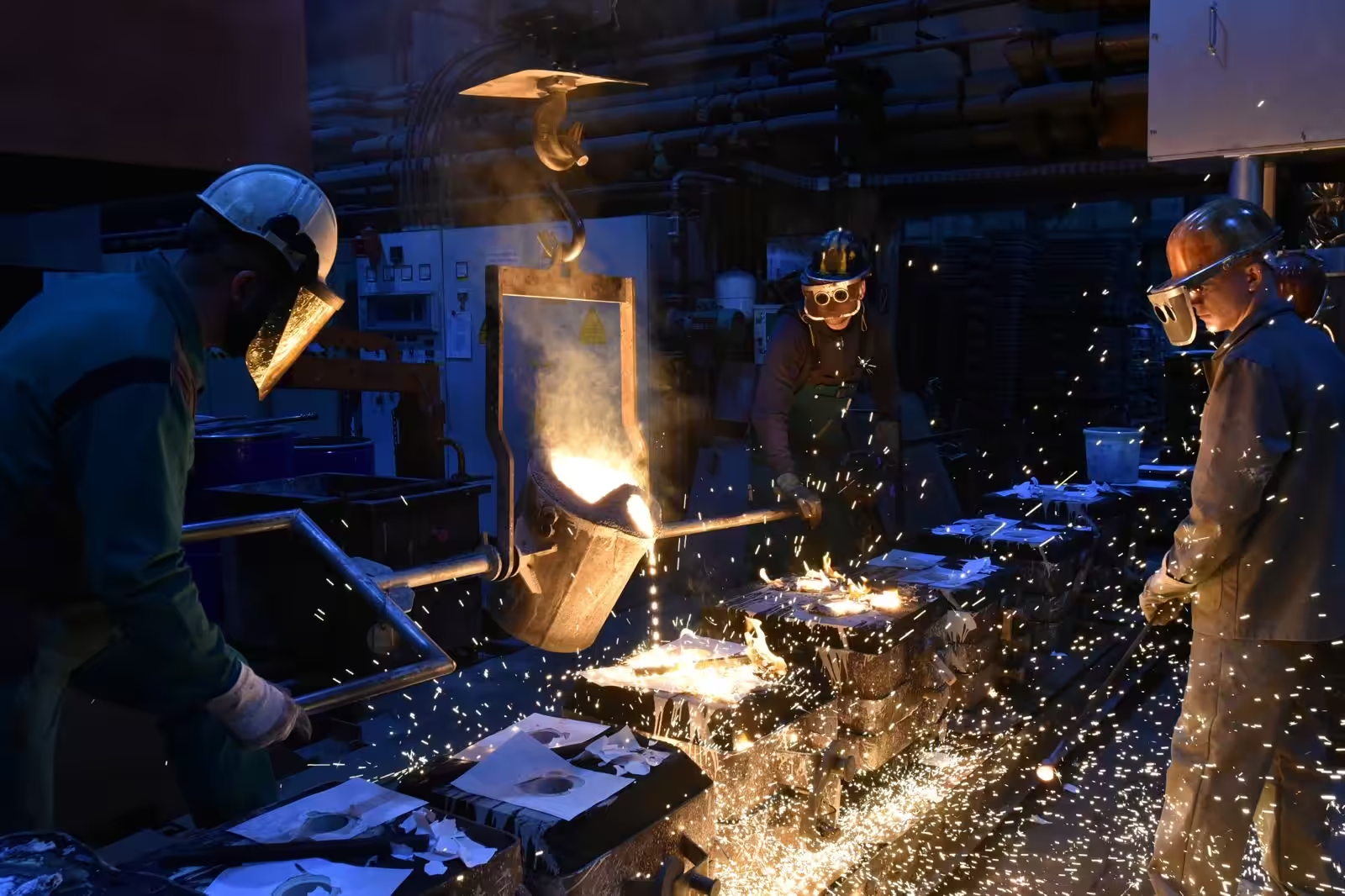
When considering the history of humanity, metallurgy has been a driving force for approximately 6,500 years, and has given us the scientific understanding that powers the technological advancements of our world today, from the humongous skyscrapers that define the city skylines to the sophisticated smartphones in our pockets.
Metallurgy is, however, not just about working with metals.
One of the basic engineering skills, it elevates countless industries and has captured the hearts and minds of its practitioners. The sheer numbers speak a fair and rousing story, ferrous metal production constitutes a whopping 95% of global metal output. Car parts, wind power stations, construction equipment are made from materials such as copper, aluminum and iron
Now, creating new materials and methodologies fuelled by metallurgy have been an economic power-house, addressing the needs of our population, and driving cutting-edge technological advances. We delve into the history, development and ongoing journey of metallurgy, from its birthplace, to recent findings. Well-known for it’s power to salvage resources, as in the cases of recycled aluminum. Since saving up to ninety-five percent of the energy, needed to produce it from raw bauxite, metallurgy is basically the bedrock that all the world’s industries sit on.
Defining Metallurgy and Its Role in Engineering
When people think about metallurgy they often believe it’s the art of working metals, and that’s not far off, but it’s actually a branch of materials science and engineering that gets to know the ins and outs of metallic elements, their chemical and physical properties, and how they mix and mingle with other metals to form inter-metallic compounds and alloys. Well-known as the science and tech behind metals, metallurgy takes in the whole process from production, right through to engineering metal components for the manufacturing sector, and everything in between.
Metallographic Sample Preparation: Expert Guide to Perfect Specimens
What is Metallurgy? and How it is different from materials science?
Regarding understanding the behavior of metals, metallurgy takes centre stage. Coming from a theoretical perspective, metallurgy is a completely different thing from metalworking, much like medicine is different from medical science. One is practical application and the other lays the foundation for the theory.
Well-known as one of the two main branches of metallurgy, chemical metallurgy is all over the place.
It’s about refining and oxidizing metals, breaking down minerals, extracting metals, thermodynamics, electrochemistry, and corrosion. On the flip side, physical metallurgy looks at the physical properties of metals. Their mechanical and thermal properties, crystals, characterizing materials, phase changes, and failure patterns.
It’s clear that they are closely linked, yet, materials science is a broadened field that was originally rooted in metallurgy, when materials science and metallurgy are brought to mind. Many metallurgical engineering programs were transformed into programs that cover materials science and engineering, and in the 1960s, materials science and engineering programs became more formalized. This modern metamorphosis of materials science was mainly triggered by the explosion in the research of high-tech plastic, ceramics and composite materials since the 1980s.
Today, metallurgy represents a key aspect of materials engineering and plays an important role in different fields. The area of materials science studies all materials together while metals and alloys are more specific.
Historical rise from Bronze Age to modern metallurgy
Looking at back ten thousand years, we see that the discovery of copper in Northern Iraq marked the beginning of metallurgy. Coming hotfooting into the picture, around 3300 BCE, was the stroke of genius that allowed people to create bronze by mixing copper with tin, and gave them the ability to make harder, sharper, and more malleable tools, weapons and ornaments. Essentially, tools that could be shaped in a way that stone or pure copper couldn’t. And so the Bronze Age began, spreading to all parts of the world where people could utilise bronze. Then, Iron working was one of the biggest breakthroughs in the history of metallurgy. Coming into its stride in Anatolia in the 1200s BCE, the Hittites nailed iron smelting, and we found ourselves in the Iron Age. Well-known because people could now make their own iron weapons at home, whereas bronze needed tin imported from other parts of the world. The 19th century was when we saw a huge leap forward in the understanding of metallurgy.
He unknowingly opened the door to a wealth of metallic materials we use today, when American scientist Josiah Willard Gibbs laid the foundation for understanding thermodynamic properties in relation to atomic structures. The Space Race, which is relatively recent in the timeline of human history, drove an unprecedented boom in metallic alloys, silica and carbon development. The techniques that have grown out of this time, are now being referred to as an intricate academic discipline in its own right. Today, contemporary metallurgical engineering, which is a synthesis of physics, chemistry, and engineering has enabled us to create materials specifically fitted to aerospace requirements, electronics, and other industries, while the engineers also go back in time to find the beginning of a material’s life cycle.
Core Branches of Metallurgy Explained
Regarding metallurgical science, the picture is quite intricate, and so, experts divide it into distinct branches. Each of these branches has its own way of understanding and managing the way metals behave and are processed. Coming from a practical standpoint, the division of metallurgy into its branches allows for the development of in-depth expertise in each area, and enables a holistic collaboration between specialists.
Extractive Metallurgy: Smelting, Leaching, and Electrolysis
Extractive metallurgy gets valuable metals from natural mineral deposits and refines them into purer forms. This branch forms the foundations of metal production and we mainly used three methods:
- Pyrometallurgy: High-temperature processes create chemical reactions among gasses, solids, and molten materials. Common operations like roasting turn sulfides into oxides, and smelting separates impure molten metal from slag.
- Hydrometallurgy: This method uses aqueous solutions to extract metals through leaching, which dissolves minerals to create an enriched solution. The process recovers dissolved metal values through precipitation, distillation, adsorption, or solvent extraction.
- Electrometallurgy: This branch employs electrolytic cells to recover metals. The process works through electrowinning that plates metal onto a cathode from a solution or electro-refining that dissolves an impure anode to create a high-purity cathode.
Physical Metallurgy: Microstructure and Phase Transformations
In the case of metals, physical metallurgy is the study of the connection between the microstructure and physical properties. This branch is all over the map, dissecting how crystal lattices, grain sizes and irregularities affect the mechanical, thermal and electrical characteristics of metals. Phase changes are the basic building blocks of physical metallurgy. They happen when a metal goes through a change in its crystalline structure, and are triggered by specific conditions.
Allotropic transformations: Changes between different crystal structures with the same composition
Eutectic transformations: Liquid solutions cool to form two or more solid phases at once
Martensitic transformations: Diffusionless transformations create distorted crystal structures
Heat treatment is the go-to technique, basically turning up the heat and then slowing it back down again, when altering the properties of metals. Coming across the words annealing, quenching and tempering, these are the three main types of heat treatment. Annealing is essentially a slow cool-down that makes metals much softer, quenching is the opposite. It rapidly cools the metal down to create its hardness, and tempering is used to knock out stresses while still keeping the hardness in place. Physical metallurgists are able to see the tiny building blocks of metals and rearrange them so that they can get the properties that they want out of the material.
Mechanical Metallurgy: Stress-Strain and Deformation Behavior
Looking at the physical properties of metals, mechanical metallurgy is the study of how metals react to forces, and in particular the relationship between stress and strain. This area of study also teaches us about elastic and plastic deformation, and as such, the properties that lie in the stress-strain curve are really interesting.
Well-known are the elastic region, the yield strength and the tensile strength, all of which can be found on the stress-strain curve, and mechanical metallurgists also examine how phenomena such as strain hardening and creep can be explained. They also go on to show us that different mechanical characteristics come to the forefront as a result of various working processes such as rolling, forging, extrusion and welding.
Chemical Metallurgy: Corrosion and Surface Reactions
Looking at the world of metallurgy you’re seeing the breakdown of the chemical composition of metals and their reactions with their surroundings. Something that is costing many countries a whopping 4% of their gross national product. Coming from the fact that metals are not very stable in their environments, and will react with the air, water and other elements to break down over time. Corrosion shows up in many different forms including.
Rockwell Hardness Testing: Essential Guide for Quality Engineers
- Uniform corrosion (material loss spreads evenly across a surface)
- Galvanic corrosion (faster corrosion happens when dissimilar metals touch)
- Pitting corrosion (localized cavities form on passive metals)
- Stress corrosion cracking (corrosion and mechanical stress work together)
In the case of the study of corrosion, chemical metallurgists don’t just focus on the problem, they also work to find solutions. One of the main techniques they use are passive films, cathodic protection systems and protective coatings, all of which slow down or prevent corrosion. Coming hotfooting into the realm of metal extraction and refining, they also delve into the electrochemical reactions that make it all happen.
Key Metallurgical Processes in Metal Production
The journey from raw ore to refined metal shows how we transform nature’s minerals into the refined metals that power our modern world. These techniques are the foundations of metal production systems worldwide.
Ore Concentration and Roasting Techniques
For metal extraction the initial process is ore concentration, a way of separating the valuable parts of the ore from the rest of the rock. Well-known methods of doing this are crushing large ore chunks into smaller pieces, which we can then grind into a fine consistency.
The concentration process itself may involve several methods including froth flotation, settling, magnetic separation and roasting. Froth flotation is achieved by mixing crushed ore into a chemical-rich slurry and binding metal particles to the surface of the water using “collectors”. We then send air bubbles through the tank to carry the hydrophobic particles, covered in this layer of chemicals, to the surface where the frothy mixture gets skimmed off.
Settling is an age-old technique, basically, that uses the fact that heavy metal particles sink at different rates than lighter impurities. It’s used in gold panning. Magnetic separation works well for iron ores like magnetite, sending magnetic particles through a magnetic field and leaving behind the non-magnetic impurities.
Roasting comes next. Heating the concentrated ore in an oxidizing atmosphere, and mainly used for sulfide ores to eliminate nasty impurities like arsenic, mercury and sulfur, these get driven out as sulfur dioxide. The heat usually peaks at around 590 degrees Celsius or 1,100 degrees Fahrenheit, but carbonate and hydrated oxide ores require a different heating process, done without oxygen, or calcination.
Petrography Explained: Essential Methods in Modern Petrology Science
Smelting and Bessemerisation in Copper Extraction
A concentrated and roasted solid is turned into a molten state, and conventional smelting is traditionally done in reverberatory furnaces, when processing metals. Here, the ore and flux. Which is largely made up of silica, but sometimes includes limestone, are heated up to around 1,230 to 1,300 degrees Celsius or 2,250 to 2,370 degrees Fahrenheit. However, flash or bath smelting have largely replaced these older methods, using less fuel and producing much lower levels of the dangerous sulphur dioxide gas that was previously a major issue.
Copper smelting produces a mixture called matte that is made of between 45 and 70% copper, which is the flux’s reaction to impurities. A light, fluid layer of slag sits on top of the matte. The Bessemer process removes any remaining impurities from the smelted mixture.
The Bessemer converter is basically a four-metre diameter cylindrical steel shell lined with refractory brick, and it’s what gets the job done.
Charging it with the matte, flux, and old copper, stirring it up and putting the tuyeres into the bubbly mixture, then sending in air that’s either normal air or enriched with oxygen, makes the iron and sulphur turn into oxides which leave the system either in the exhaust gas or the slag, and gives off “blister” copper that is about 98.5 to 99.5% pure. The name of the process comes from the blisters that appear on the surface when the sulphur dioxide escapes and cools.
Electrolytic Refining for High-Purity Metals
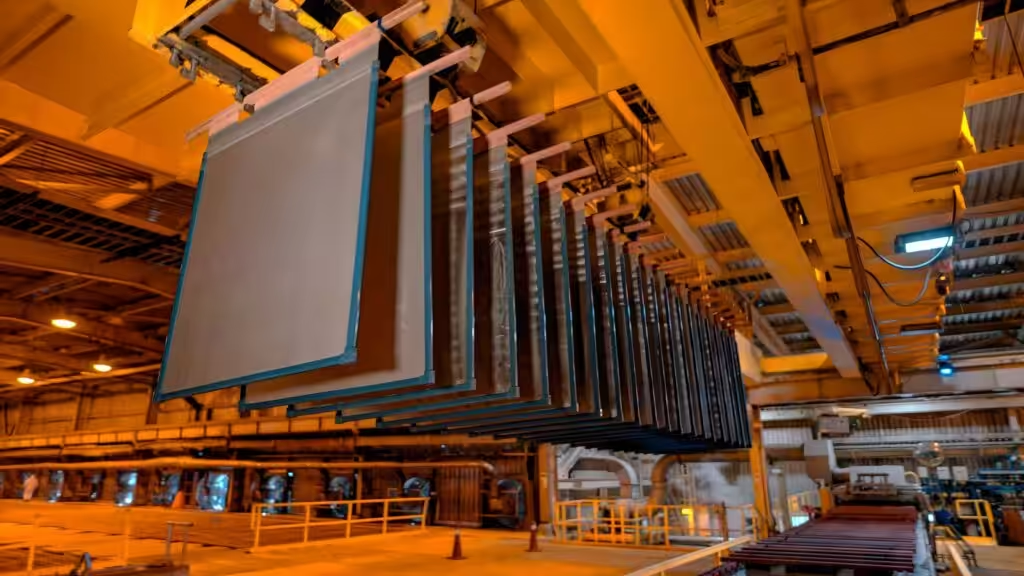
Electrolytic refining produces the highest metal purities—a significant final step for many industrial applications. The process needs:
- An impure metal anode (usually 99.5% pure copper)
- A pure metal cathode starter sheet
- An electrolyte solution (copper sulfate and sulfuric acid for copper refining)
- Applied electric current
It’s the anode that’s completely dissolved into the electrolyte, depositing pure copper onto the cathode. A process that can yield copper cathodes that are virtually 100% pure, when electroplating copper. Unfortunately, precious metals such as gold and silver tend to sink to the bottom of the cell, collecting in what is referred to as “anode slimes” and need to be reprocessed, a less efficient and less energy friendly process.
Electrolytic copper production is energy intensive, requiring 260-280 kWh per tonne. Coming in at a hefty 60-70% of the overall energy input, this is mainly due to the need for such high levels of purity.
Alloying and Heat Treatment Techniques
Looking at to control the properties of metals, the art of metallurgy offers a means to manipulate these characteristics. By careful control of a metal’s composition and thermal processing, engineers can transform it, turning it into something that would not have been possible in its natural form.
Alloying for Strength and Corrosion Resistance
Alloying creates a new phase with properties that are different from the original material. This is achieved by introducing barriers to slip within the crystal lattice, when engineering metals. The primary use of alloying is to harden metals, and this is achieved by increasing the difficulty in dislocation movement in the metal crystal structure. This can be done through the substitutional elements that swap places with the matrix atoms on regular lattice sites, and interstitial elements that are smaller and occupy the spaces between regular sites.
Mutually beneficial alloying brings a number of benefits, as it has produced the corrosion-resistant stainless steels, of which the addition of chromium and aluminum created a shielding oxide film. With no less than eleven percent of chromium is necessary to build this protective shield. Titanium alloys take on a different approach, using molybdenum stabilizes, which perform much better in halting corrosion.
Cold rolled, and fine-tuned Ti-Mo alloys, basically unscathed in a five percent hydrochloric acid solution, thanks to a protective layer of MoO3 and TiO2 mixture that acts as a barrier. The art of forging corrosion-resistant alloys has been turned upside down by the publication of the first instruction book for developing new alloys with corrosion resistant properties.
What is Metallography? Definition, Techniques & Industrial Applications
Powder Metallurgy in Precision Manufacturing
As for precision engineering, powder metallurgy is a highly skilled and highly effective way of manufacturing alloys that contain metallic powders. Mixing metals and different powders to create more powerful, durable and heat-resistant alloys is basically what it’s all about, and this is something that can’t be achieved by traditional casting methods.
Tungsten alloy powder is used for making armor-piercing projectiles, and high-temperature resistant powders are used in high-voltage applications.
The powder metallurgy components usually need to be given a heat treatment after they’re made, and surface coatings are applied, all of which can give them superior mechanical strength, wear resistance and protection against corrosion. Treatments like sinter hardening for extra hardness, carburizing for slicker surfaces, and annealing to get rid of internal stresses are also possible.
Heat Treatment: Annealing, Quenching, and Tempering
Heat treatment changes metal microstructure through controlled heating and cooling. This process alters mechanical properties without changing shape. The key processes include:
- Annealing: The metal heats to a specified temperature, maintains it, then cools slowly—usually in the furnace itself. This process softens the metal, increases ductility, relieves internal stresses, and refines grain structure. Full annealing creates a coarse pearlite structure, while process annealing happens between stages of cold working.
- Quenching: The heated metal cools rapidly in media like water, oil, or air. This process “freezes” metallic crystals in a chaotic state instead of letting them reform in their normal arrangement. The result is substantially increased hardness. Quenched metals often remain too brittle for practical use without subsequent tempering.
- Tempering: This vital follow-up to quenching reheats metal to a temperature below its critical point, followed by slow cooling. The process balances strength and flexibility by reducing brittleness while keeping most hardness. Tempering relieves internal stresses, improves ductility and toughness, makes machining easier, stabilizes dimensions, and can reduce hardness to desired levels.
These techniques illustrate how metallurgy controls material properties at the microstructural level. Engineers can precisely tailor metals for specific applications—showing metallurgy in its most practical form.
Applications of Metallurgy in Modern Industries
Concerning turning theoretical ideas into real-world, industrial-scale applications metallurgical know-how plays a key role. It fills the space between the lab and the factory, making complex scientific principles into usable solutions. Well-known manifestations of metallurgical expertise include the high-performance materials that are driving the growth of industries all over the world.
Stainless Steel: A Practical Guide to Metallographic Preparation
Aerospace and Automotive Component Engineering
With respect to the aerospace industry, the materials being used must be able to withstand the harshest of conditions. Metallurgists therefore design parts that can survive extreme heat and maintain their structural integrity. Identification, characterization and control over the production process allows them to create lighter, stronger and more corrosion-resistant structures.
Aluminum is the preferred infrastructure material for aerospace applications. Unlike conventional metals, it has an extraordinary balance of weight and strength. Titanium alloys add to the list of strengths by forming an exceptionaly robust structures to such levels that naturally form a hard barrier that resists corrosion. Jet engines require special materials capable of outperforming in temperatures above 1600°C, and materials so resilient are called ‘superalloys’ whose properties give them a significant capability to stop creep, a serious condition when metals warp under stress. The automobile manufacturers are making the most of the advantages that these materials have. Powder metallurgy is able to send shockwave boosters to high-pressure components.
Construction and Infrastructure Materials
Engineers demand that the components can withstand the harshest conditions, when developing materials for the aerospace industry. Metallurgists have responded by creating alloys that can survive extreme temperatures and still maintain structural integrity, and thanks to the techniques of identification, characterisation, and quality control, they have been able to produce components that are much lighter, yet stronger and more resistant to corrosion.
Aluminium alloys are practically synonymous with aerospace applications, with an unusually high weight-to-strength ratio, and their performance is no coincidence. The aerospace industry is very aware of the value of titanium alloys, so they’re giving aircraft structures the ability to be incredibly strong yet very lightweight, and naturally create a protective oxide layer to shield against corrosion. Jet engines are powered by superalloys that function flawlessly at temperatures above 1600 degrees Celsius, supplying the necessary structural strength and resistance to creep. A very critical feature in the safe operation of these high-speed engines. The car industry is reaping the benefits of this metallurgical progress.
Powder metallurgy provides high-strength and high-performance metal parts to boost the strength, toughness and accuracy of machinery. The strength-to-weight ratio of these precision-engineered components makes them ideal for drivetrain parts and electric vehicles.
Electronics and High-Performance Alloys
Engineers demand that the components can withstand the harshest conditions, when developing materials for the aerospace industry. Metallurgists have responded by creating alloys that can survive extreme temperatures and still maintain structural integrity, and thanks to the techniques of identification, characterisation, and quality control, they have been able to produce components that are much lighter, yet stronger and more resistant to corrosion.
Aluminium alloys are practically synonymous with aerospace applications, with an unusually high weight-to-strength ratio, and their performance is no coincidence. The aerospace industry is very aware of the value of titanium alloys, so they’re giving aircraft structures the ability to be incredibly strong yet very lightweight, and naturally create a protective oxide layer to shield against corrosion. Jet engines are powered by superalloys that function flawlessly at temperatures above 1600 degrees Celsius, supplying the necessary structural strength and resistance to creep. A very critical feature in the safe operation of these high-speed engines. The car industry is reaping the benefits of this metallurgical progress.
Powder metallurgy provides high-strength and high-performance metal parts to boost the strength, toughness and accuracy of machinery. The strength-to-weight ratio of these precision-engineered components makes them ideal for drivetrain parts and electric vehicles.
Material Characterization and Testing Methods
As analysing metals you’re essentially looking at the intricate microstructure that makes them tick.
Microscopic Analysis: Grain Boundaries and Phases
Coming down to the microscopic level, scientists examine the internal make-up of metals on a scale that’s too small for the human eye to see. They see individual grains in the metal’s crystalline structure which have a huge impact on the metal’s strength and pliability, and the boundaries where these grains meet are also critical to understanding the mechanical properties.
Well-known steps in preparing a sample for microscopic analysis are grinding, polishing it so that it’s mirror-like, then etching to expose the intricate details. Light microscopy, in particular, offers the use of 25-1000x magnification in reflected light, and allows us to visualise grain structures. Electron microscopy then zeroes in on even smaller features, and shows them on an atomic level. Hard and soft areas in the sample are even recognisable without etching, via differential interference contrast.
How to Prepare Metallographic Samples – Complete Step-by-Step Guide (With Expert Tips)
Hardness and Tensile Strength Testing
Hardness testing is the way to go, it’s faster than tensile testing and is essentially used as a substitute, when testing the resistance of a metal to penetration.
Rockwell hardness testing measures the depth that a diamond indenter penetrates a sample under a fixed load, minus the elastic part.
This is good for mid-range to hard materials, and requires very fine sanding to get a clean surface.

The Brinell test calculates the ratio of the weight applied to the area of indentation, it’s perfect for forgings and cast irons, and takes the average of different microstructural features into account. Smaller items and case depth determinations require the use of Vickers and Knoop tests.
Spectroscopy for Elemental Composition
Spectroscopy is the way to go, and energy dispersive X-ray spectroscopy is no exception, when examining the chemical makeup of something. This technique is able to detect the X-rays that are emitted as an electron beam sweeps across the surface of a sample, and each element in the periodic table has its unique X-ray line profile.
Foundries make use of optical emission spectroscopy to take a closer look at metals and alloys of any sort. They create characteristic optical emissions by sending electrical sparks over the surface of a sample and then use a diffraction grating to separate the light into element-specific wavelengths that can be used to work out the concentration.
Well-known as the backbone of engineering and technological advancement, metallurgy.
Or the science and technology of extracting metals, started in a relatively primitive state but has over time evolved to become what we know today. This process, which involves four principal divisions: Extractive metallurgy, physical metallurgy, mechanical metallurgy and micro-structure transformations. The story goes from its beginnings with rudimentary copper workings 10,000 years ago, and up to high-stakes engineering science. Coming to life through leaps and bounds as the technology we possess has been bettering, metallurgy showcases how this area was developed hand in hand with advancements in the past.
At its core, metallurgy, as well as getting metals out of their ores, entails smelting and leaching. Physically changing the properties of metals is the domain of physical metallurgy. It’s all about analyzing the minute details at the heart of a metal’s microstructure and the phase changes that happen. Mechanical metallurgy is basically concerned with the stress and strain that metals undergo.
The world of metallurgy is changing quickly. Improved alloys show up regularly and are used to combat extreme environments, and materials that resist corrosion save billions of dollars in maintenance and repairs.
Metallurgy, incidentally, is far from being about just metals, it’s where science, engineering and manufacturing intersect. This basic, yet critical discipline is at the heart of technological progress, and we can count on it being the starting point for brand-new ideas that are going to change the world.
Artificial Intelligence Summary
You can watch a video summary of this article. This summary video was created using artificial intelligence.
FAQ about Metallurgy
Q1. What is metallurgy and why is it important?
When discussing metals, Metallurgy is the study and technology that gets them from the earth to the shelves, where we can use them in everything from smartphones to towering skyscrapers.
Q2. What’s the difference between metallurgy and materials science?
Coming from a different perspective, Materials Science looks at all sorts of materials, from ceramics and plastics to composites, and metallurgy has essentially been a subfield of this discipline.
Q3. What are the primary branches of metallurgy?
Metallurgy is broken down into four main areas, namely extractive metallurgy, physical metallurgy, mechanical metallurgy and chemical metallurgy.
Q4. How do alloying and metal properties improve?
We get a new, more powerful material that also offers corrosion resistance. This is the definition of alloying, when mixing different metals. It creates barriers that block movement of crystal grains to harden and strengthen the material, and can even generate protective surface layers.
Q5. Where does metallurgy fit in the aerospace industry?
With specialized alloying techniques, and new aircraft structural components and engine components are created and improved. Hardening and strengthening for aircraft components can withstand anything from scorching heat to freezing temperatures, to protect the stability of the flight performance.
References
-
http://ndl.ethernet.edu.et/bitstream/123456789/4890/1/197.pdf
-
https://www.britannica.com/technology/copper-processing/Roasting-smelting-and-converting
-
https://mechanicalc.com/reference/mechanical-properties-of-materials
-
https://public.ksc.nasa.gov/corrosion/corrosion-fundamentals/
-
https://www.sciencedirect.com/science/article/abs/pii/S0892687519300901
-
https://www.sciencedirect.com/science/article/abs/pii/S2352492824030939
-
https://engineering.asu.edu/news/designing-alloys-for-corrosion-resistance/
-
https://www.cabww.com/wp-content/uploads/2024/06/CorrelationHardnessTensile-wp.pdf


