
The Future of Metallography: How Automation is Transforming Sample Preparation
The Future of Metallography: How Automation is Transforming Sample Preparation
Metallography has long been the foundation of materials science — a discipline that gives engineers and researchers an unfiltered view into a material’s microstructure, phase composition, grain boundaries, and defect patterns. For decades, producing a reliable metallographic sample required considerable manual skill: grinding, polishing, etching, and microscopic inspection each depended on the experience of the technician performing them. That era is not over, but it is changing rapidly.
Automation is reshaping how laboratories prepare and analyze metallographic samples. From fully integrated grinding and polishing systems to AI-assisted image analysis, the shift toward automated workflows is delivering faster throughput, greater reproducibility, and significantly reduced operator dependency. For quality control teams in aerospace, automotive, foundry, and advanced manufacturing, this transformation is not merely a convenience — it is a competitive requirement.
Why Manual Sample Preparation Has Its Limits
Manual metallographic preparation is inherently variable. Pressure applied during grinding, polishing time, abrasive selection, and etchant exposure all affect the quality of the final surface — and all are subject to human inconsistency. A technician who is rushed, fatigued, or simply less experienced may produce a section that introduces preparation artifacts, masking the true microstructure of the material.
Beyond consistency, throughput is a persistent challenge. High-volume production environments — where dozens of samples per shift may require metallographic verification — can quickly overwhelm manual preparation capacity. The result is either a bottleneck in the quality control pipeline or a reduction in inspection frequency, neither of which is acceptable in industries with tight tolerances and regulatory obligations.
Automation directly addresses both of these constraints by removing the human variable from repetitive, process-controlled tasks while freeing experienced metallographers to focus on analysis and interpretation.
Automated Sectioning and Mounting
The sample preparation chain begins with sectioning. Precision cutting wheels with programmable feed rates, speeds, and coolant delivery ensure that the initial cut introduces minimal heat and deformation — both of which can alter the microstructure being studied. Modern automatic cut-off machines allow operators to store cutting programs for recurring sample types, ensuring that the same material is always sectioned under the same conditions regardless of who operates the machine.
Mounting, the next step in encapsulating samples within resin for easier handling, has similarly benefited from automation. Automatic mounting presses with programmable temperature, pressure, and cycle time profiles eliminate the guesswork from hot compression mounting. The result is consistent mold geometry, optimal resin fill, and controlled hardening — attributes that directly influence the quality of subsequent grinding and polishing steps.
Intelligent Grinding and Polishing Systems
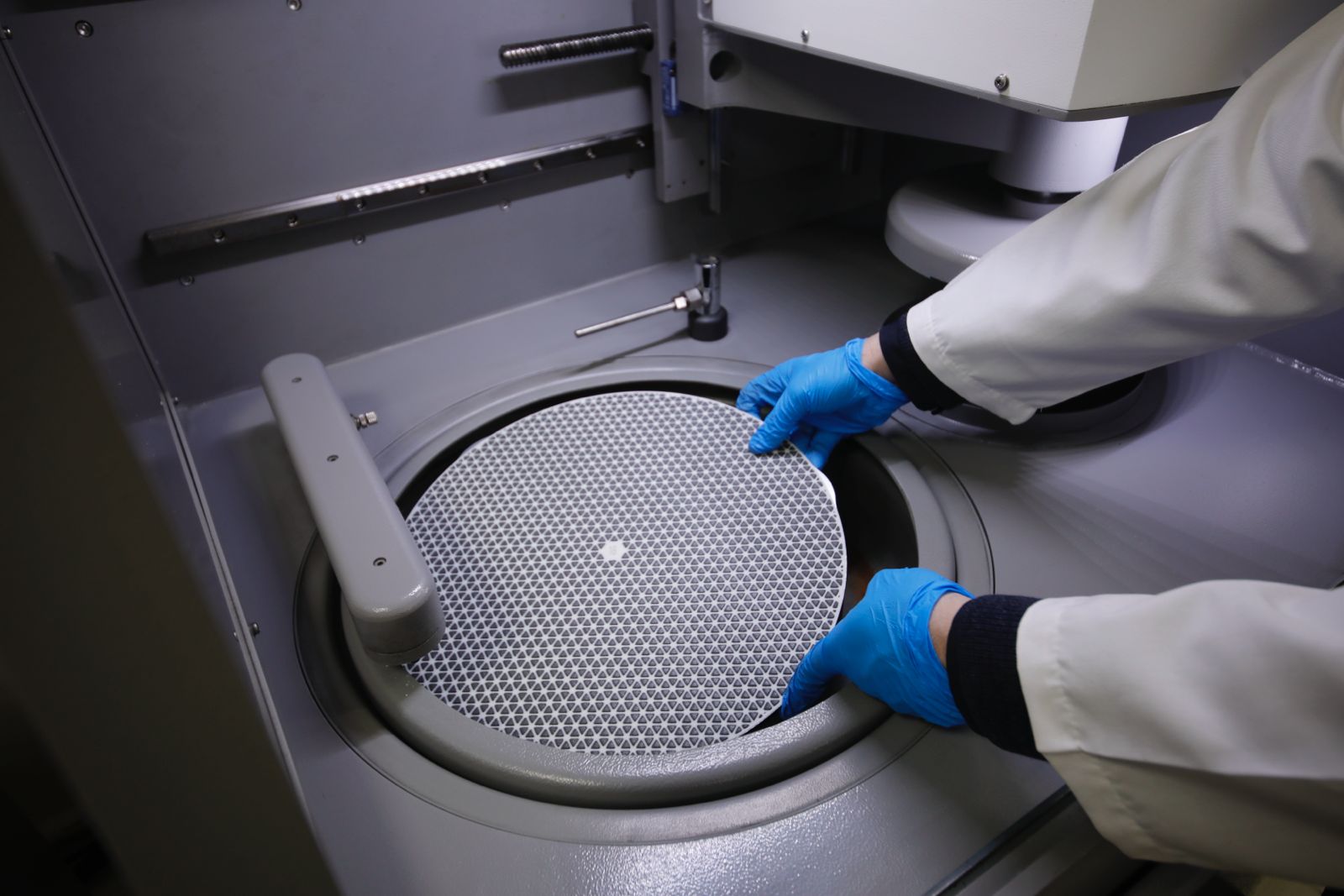
If there is a single step in metallographic preparation where automation has made the most visible impact, it is grinding and polishing. Automated grinder-polishers allow laboratories to define complete preparation sequences — abrasive type, grit progression, rotational speed, applied force, and step duration — and execute them with mechanical precision across multiple samples simultaneously.
Contra-rotation of the sample head relative to the platen, force control at the individual specimen level, and closed-loop feedback on material removal rate are features that simply cannot be replicated manually. The ability to store and recall preparation methods for specific alloys — whether hardened tool steel, titanium alloy, or aluminum casting — gives laboratories a methodological library that scales with their workload without increasing staffing requirements.
For facilities preparing samples continuously, robotic sample handling systems can further integrate these steps — transferring mounted specimens from mounting press to grinder-polisher to microscope staging area with minimal human intervention. These systems are particularly valuable in 24-hour production environments or in laboratory settings where operator exposure to grinding media and chemical etchants poses health and safety concerns.
VELOX 102: A Case Study in Fully Automated Sample Preparation
Among the systems that best illustrate where automated metallographic preparation is heading, the VELOX 102 from Metkon stands out as a particularly comprehensive example. Designed from the outset for operator-free, high-volume sample throughput, the VELOX 102 integrates every stage of the preparation workflow — from planar grinding through to final cleaning and drying — into a single, programmable platform.
The operating concept is deliberately straightforward: the operator loads sample holders into the auto-feed rack, selects the appropriate preparation program for the material in question, and presses start. From that point, the system takes over entirely. Up to six specimen holders can be queued simultaneously, allowing non-stop preparation runs without any manual intervention between batches.
What makes the VELOX 102 architecturally notable is that it consolidates functions that would ordinarily require separate standalone machines into a footprint of just over two meters in width — an important consideration for laboratories where floor space is at a premium. The system comprises six integrated subsystems:
- A planar grinding station equipped with a 4 kW motor, accommodating Ø300 mm flat grinding stones with automatic dressing capability — ensuring consistent material removal rates and surface flatness across every sample in the batch.
- A fine grinding and polishing station with a 1.1 kW motor, adjustable between 50 and 600 RPM, accepting Ø250 mm discs for the intermediate and final preparation stages.
- An automatic disc exchange system capable of storing and deploying up to 10 different grinding and polishing discs, switching between them automatically according to the selected preparation recipe — and notifying the operator when any disc has reached the end of its service life.
- An automatic sample holder replacement and feeding system that retrieves each specimen holder from the queue in sequence, transfers it to the preparation stations, and returns it upon completion — enabling continuous overnight or shift-long runs without supervision.
- A fully automatic cleaning and drying station that subjects each prepared sample to a programmable sequence of pressurized water washing, ethanol rinsing, ultrasonic cleaning, and filtered air drying — eliminating the manual rinsing step that is often the most inconsistently performed part of the preparation chain.
- An automatic peristaltic dosing unit with eight independent pumps — six dedicated to diamond suspensions and lubricants, two to aluminum oxide suspensions — with cartridge-based refill, magnetic stirrers, pre-dosing capability, and automatic liquid level monitoring.
The control architecture is built around a Siemens PLC with a 9.7-inch color touchscreen HMI, with memory for up to 20 preparation programs. Safety light curtains on two sides provide both operator protection and unattended operation confidence. The robust steel construction and industrial-grade electrical components are rated for continuous 24/7 operation — a specification that reflects the system’s intended deployment in production-line quality control environments rather than occasional research use.
From a laboratory management perspective, the VELOX 102 addresses the grinding and polishing bottleneck not by speeding up individual steps, but by eliminating the idle time between them. Disc changes, sample transfers, cleaning cycles, and reagent dosing — tasks that collectively account for a significant portion of a technician’s time in a manual workflow — are all executed automatically and in parallel with the preparation steps where possible. The practical result is a throughput multiplier that becomes increasingly significant as daily sample volumes rise.
Digital Imaging and AI-Assisted Microstructural Analysis
Sample preparation is only half the equation. Once a surface is ready for examination, digital microscopy and image analysis software have transformed what laboratories can measure, quantify, and communicate from a single metallographic section.
Modern metallographic microscopes equipped with motorized stages and high-resolution digital cameras can automatically scan a sample surface, stitch together large-area mosaics, and deliver a comprehensive view of microstructural features across the entire section rather than a single field of view. This is particularly valuable for heterogeneous materials where defects or phase variations may be sparsely distributed.
Image analysis software has matured to the point where grain size measurement, phase fraction quantification, inclusion rating, porosity mapping, and layer thickness measurement can all be performed automatically to recognized standards such as ASTM E112 or ISO 643. The operator defines the measurement protocol; the software executes it consistently across hundreds of images without fatigue or interpretive drift.
The integration of machine learning and artificial intelligence is now extending these capabilities further. AI models trained on large metallographic datasets can classify microstructural constituents, detect anomalies that deviate from baseline specifications, and flag samples for human review — all in real time. This positions metallographic analysis not merely as a retrospective quality check but as a proactive process monitoring tool.
Connectivity, Data Management, and Laboratory Integration
Automated equipment is only as valuable as the data it generates and communicates. Increasingly, metallographic instruments are designed for connectivity — exporting preparation parameters, imaging data, and measurement results directly to laboratory information management systems (LIMS), quality databases, or manufacturing execution systems (MES).
This connectivity enables something that manual workflows cannot easily achieve: a complete, traceable record of every sample’s preparation history linked to its analytical results. When a production batch is later subject to a quality dispute or regulatory audit, laboratories with integrated data systems can retrieve not just the microstructural images but the exact preparation conditions under which they were produced.
For multi-site organizations, networked data management allows standardized preparation methods to be deployed across geographically distributed laboratories, ensuring that a metallographic result produced in one facility is directly comparable to one produced in another — a requirement for global supply chain quality assurance programs.
The Evolving Role of the Metallographer
Automation does not eliminate the need for expertise in metallography — it redefines where that expertise is applied. Tasks that once consumed the majority of a metallographer’s time, such as manual grinding sequences and routine image capture, are delegated to automated systems. What remains — and what becomes more central — is the expert interpretation of microstructural findings, the design of preparation protocols for novel materials, the diagnosis of complex failure modes, and the correlation of microstructural data with mechanical performance.
In this sense, automation elevates the discipline. Metallographers who once spent significant time in mechanical preparation can redirect their expertise toward higher-value analytical work. Laboratories that embrace this transition are not replacing skilled personnel — they are amplifying the impact those personnel can have.
Conclusion
The trajectory of metallography points clearly toward greater automation, deeper digital integration, and more intelligent analysis. Laboratories that invest in automated sample preparation and digital microscopy today are building the infrastructure for a materials characterization workflow that is faster, more reproducible, and more informative than anything achievable through manual methods alone.
Systems such as the VELOX 102 represent the current state of the art in this transition — platforms that convert the grinding and polishing stage from a skilled manual task into a programmed, repeatable, and supervisory-free process. For manufacturers operating in high-stakes industries — where a single undetected microstructural anomaly can translate into a field failure, a warranty claim, or a safety incident — the case for automation in metallography is straightforward. It is not about replacing craft with machinery. It is about applying the right tools to the right tasks so that human expertise is concentrated where it creates the most value: in understanding materials, not just processing them.


