Choosing the Right Hardness Testing Method for Industrial Applications
Choosing the Right Hardness Testing Method for Industrial Applications
Hardness is one of the most routinely measured mechanical properties in industrial materials characterization — yet it is also one of the most easily misapplied. The term ‘hardness’ does not describe a single intrinsic material property but rather the resistance of a surface to plastic deformation under a defined indentation geometry, load, and dwell time. Because each standardized hardness method defines its own indenter geometry, load range, measurement approach, and conversion conventions, results obtained from different methods are not directly interchangeable — even when expressed through empirical conversion tables, which carry significant uncertainty across material classes.
Selecting the appropriate hardness testing method for a given industrial application requires a systematic evaluation of several interacting factors: the specimen geometry and size, the expected hardness range, the required spatial resolution, whether the measurement must characterize bulk material or a localized microstructural feature, the surface preparation constraints, the applicable material standard, and the production throughput requirements. Making the wrong choice produces data that is at best imprecise and at worst structurally misleading — a particular risk in quality control environments where hardness results feed directly into acceptance or rejection decisions.
This article provides a technically grounded framework for method selection across the principal hardness testing techniques used in industrial metallography: Vickers, Rockwell, Knoop, Brinell, and instrumented indentation. It addresses the physical basis of each method, the applications for which each is suited, the critical parameters that govern result quality, and the common error modes that compromise measurement validity.
Physical Basis and Scale of Each Method
Vickers Hardness (HV)
The Vickers method uses a square-based diamond pyramid with a face angle of 136° applied at loads ranging from approximately 9.8 mN (microhardness, HV 0.001) to 294 N (macro hardness, HV 30). The residual indent is square in cross-section; hardness is calculated from the mean diagonal length measured optically under a calibrated microscope. The formula is HV = 0.1891 × F / d², where F is load in newtons and d is the mean diagonal in millimeters.
The defining advantage of the Vickers method is scale independence: the same indenter geometry is used across the full load range, producing geometrically similar indents at any load. A result obtained at HV 0.1 can in principle be directly compared to a result at HV 10 for the same material, provided the material is homogeneous at both scales. This makes Vickers the most versatile method for cross-scale studies, case depth profiling, and phase-level microhardness mapping.
Rockwell Hardness (HR)
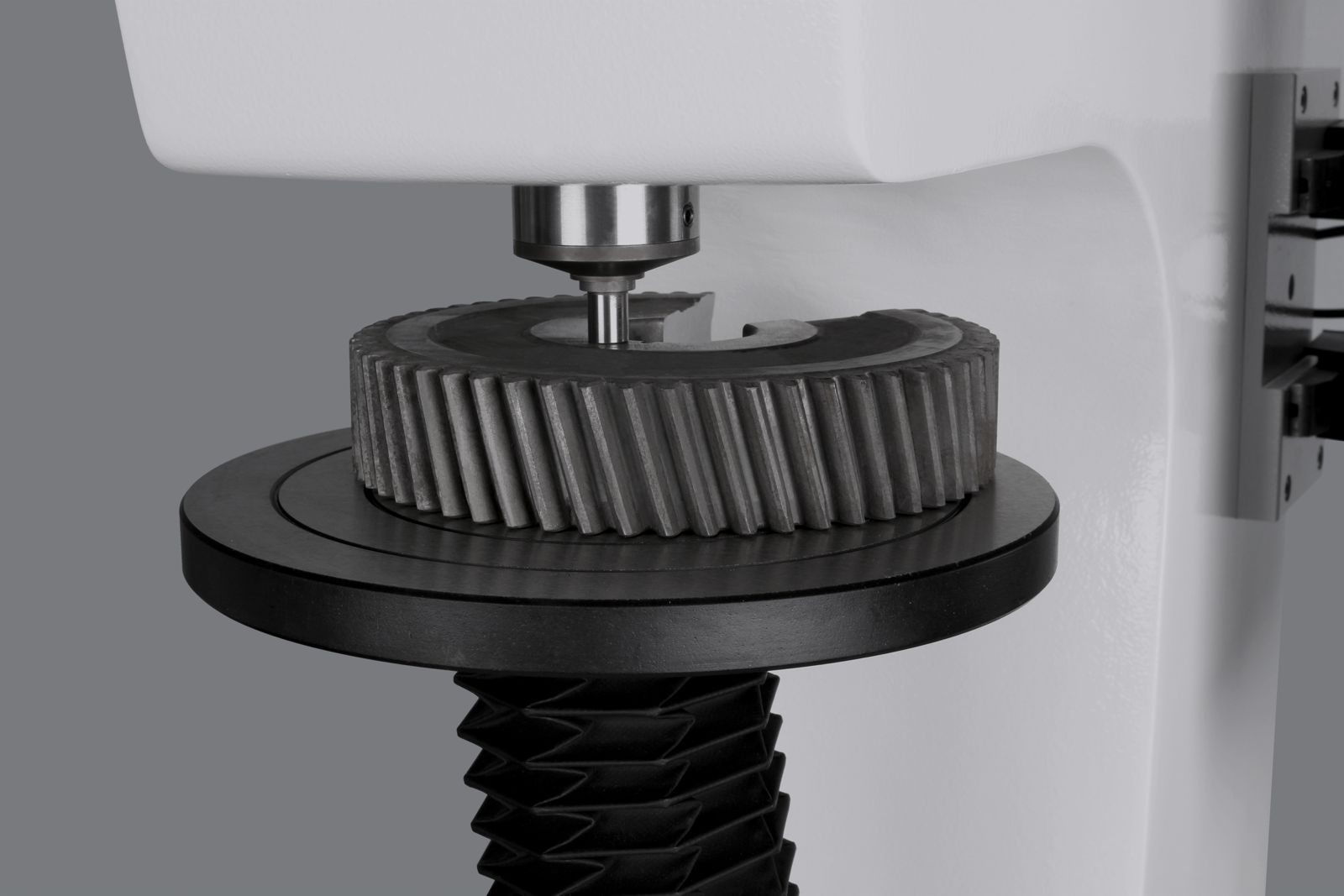
The Rockwell method measures hardness as the difference in indentation depth between a minor preload (10 kgf in conventional Rockwell) and a major load applied for a defined dwell period. The result is read directly from a dial or digital display without requiring optical measurement, making Rockwell the fastest and most operator-independent method for bulk testing. The HRC scale (120° diamond Brale indenter, 150 kgf major load) is the industrial standard for hardened steels; HRB (1/16″ steel ball, 100 kgf) is used for softer materials such as annealed steels, aluminum alloys, and copper alloys.
The Rockwell method’s speed and simplicity come with geometric limitations. The large indenter and high loads produce indentation depths and diameters that preclude testing of thin sections, case layers, coatings, small cross-sections, or specimens where the indentation must be positioned within a defined microstructural region. The minimum specimen thickness for HRC is approximately 10 times the indentation depth — in practice, 1.5 to 2 mm — and the minimum distance from the specimen edge to the indent center is 2.5 times the indent diameter.
Knoop Hardness (HK)
The Knoop indenter is an elongated rhombic diamond pyramid with longitudinal to transverse diagonal ratio of approximately 7:1. Under the same load, the Knoop indent is shallower than a Vickers indent, and the contact area is smaller along the short axis. These geometric properties make Knoop preferable to Vickers in two specific situations: testing of brittle materials — including ceramics, glass, and hardened tool steels — where the shallower impression reduces cracking; and testing of thin layers or highly anisotropic microstructures where the indent must remain entirely within a narrow region and lateral cracking perpendicular to the short diagonal must be minimized.
Knoop hardness is calculated from the long diagonal length only: HK = 14.229 × F / d², where d is the long diagonal in millimeters. Because only one diagonal is measured, Knoop is faster than Vickers for routine microhardness work, but the elongated indent geometry increases the minimum spacing required between adjacent indents along the long axis — a constraint that must be accounted for in case depth traverses and phase-mapping routines.
Brinell Hardness (HB)
The Brinell method uses a hardened steel or tungsten carbide ball indenter at loads ranging from 1 to 3000 kgf. Hardness is calculated from the diameter of the residual circular impression measured with a calibrated optical system: HB = 2F / (πD(D − √(D² − d²))), where D is ball diameter and d is impression diameter. Because the large ball indenter averages over a relatively large material volume — typically several square millimeters — Brinell is inherently insensitive to local microstructural heterogeneity. This averaging characteristic makes it the preferred method for cast irons, aluminum castings, forgings, and other materials with coarse or inhomogeneous microstructures where a microhardness measurement would produce high scatter dependent on the exact indent location relative to phases, graphite nodules, or dendrite arms.
Brinell is standardized for test forces and ball diameters such that the force-to-ball-diameter-squared ratio (F/D²) remains constant across different test scales; recommended values are 1, 2.5, 5, 10, and 30. Using mismatched F/D² ratios compromises geometric similarity and introduces systematic scale-dependent errors. The method is not suitable for thin specimens, coatings, surface-hardened layers, or any application where the indentation must be spatially localized.
Instrumented Indentation (ISO 14577)
Instrumented indentation testing — sometimes referred to as nanoindentation at sub-mN loads or depth-sensing indentation across the broader range — continuously records load and displacement throughout the indentation cycle and derives hardness (HIT) and elastic modulus (EIT) from the load-displacement curve using the Oliver-Pharr analytical framework. Unlike all conventional methods, instrumented indentation does not require optical measurement of residual indent dimensions; the mechanical response of the material during loading and unloading constitutes the primary dataset.
This approach is indispensable for applications where the volume of interest is too small for conventional optical indent measurement — thin films, PVD and CVD coatings, oxide layers, individual microstructural phases in polyphase alloys, and biomaterials. The depth resolution of modern instrumented indenters is sub-nanometer, enabling characterization of layers just tens of nanometers thick when substrate influence is appropriately managed through careful load selection relative to film thickness. The primary technical challenge is calibration of the indenter tip area function, which governs the accuracy of all derived quantities.
Method Selection by Application Category
Bulk Hardness of Wrought and Cast Alloys
For routine acceptance testing of wrought steel components — bar stock, forgings, machined parts — Rockwell HRC or HRB is the standard method. It is fast, requires minimal surface preparation beyond a clean, flat surface, and does not require optical measurement. For castings with coarse microstructures, Brinell with a 10 mm ball at 3000 kgf (HBW 10/3000) provides better statistical representation of the bulk hardness than either Rockwell or Vickers, because the large indentation averages across multiple phases and heterogeneous regions.
For specimens where the contact area of the Brinell ball would introduce geometric errors — small cross-sections, thin-walled tubes, specimens under 6 mm in any dimension — Vickers at moderate loads (HV 5 to HV 30) provides bulk hardness data with better spatial specificity and without the minimum thickness constraints of Rockwell.
Case-Hardened and Surface-Treated Components
Effective case depth determination — whether for carburized, nitrided, induction-hardened, or laser-hardened components — requires a traverse of microhardness measurements from the surface into the core, with sufficient indent density to resolve the hardness gradient at the case-core transition. Vickers at HV 0.3 to HV 1 is the standard for case depth traverses because it provides adequate spatial resolution, optically measurable indents, and results that directly satisfy the requirements of ISO 2639 (effective case depth of carburized components) and other case depth standards. Knoop at equivalent loads is acceptable for materials prone to cracking under the Vickers pyramid, particularly highly carburized surfaces at high surface hardness levels.
The minimum spacing between indents in a traverse must satisfy the standard requirement — typically three indent diagonals between adjacent indent centers for Vickers — and the traverse must begin at a defined minimum distance from the surface to avoid the influence of surface roughness on the first indent. For nitrided components where the compound layer is typically only a few micrometers thick, characterizing layer hardness requires loads below HV 0.025 and careful focus on surface preparation quality.
Thin Coatings, PVD/CVD Films, and Surface Layers
The fundamental constraint in hardness testing of coatings is substrate influence: when the plastic deformation zone extends significantly into the substrate material, the measured hardness reflects a composite response rather than the coating’s intrinsic resistance. A widely applied empirical rule is that the indentation depth should not exceed 10% of the coating thickness to avoid substrate influence. For a coating 5 µm thick, this implies a maximum indentation depth of 500 nm — achievable in microhardness only at very low loads, and more reliably addressed by instrumented indentation where depth is directly controlled and monitored.
For coatings above approximately 20 µm in thickness, Vickers at HV 0.025 to HV 0.1 typically provides acceptable coating-representative data without instrumented indentation equipment. Below 20 µm, and certainly below 5 µm, instrumented indentation is the technically appropriate method, with substrate correction applied analytically if needed.
Weld Hardness Surveys
Hardness surveys of welded joints — mapping the weld metal, heat-affected zone (HAZ), and unaffected base material — are performed to assess the risk of hydrogen-induced cracking, characterize softening in precipitation-hardened alloys, verify post-weld heat treatment effectiveness, and satisfy requirements of welding procedure qualification standards such as ISO 15614 and AWS D1.1. Vickers at HV 1 or HV 5 is the method specified in most weld qualification standards for metallic materials; the load selection depends on HAZ width relative to the minimum indent spacing permitted by the standard.
Weld surveys typically require a minimum of three traverses — one near each surface and one at mid-thickness — each covering a defined lateral extent beyond the weld fusion line. Automated hardness testing systems with motorized stages and programmed indent patterns significantly reduce the operator time and positioning error associated with multi-indent weld surveys, and are increasingly standard for high-volume qualification testing programs.
Brittle and Ceramic Materials
Ceramics, hardened tool steels, cemented carbides, and intermetallic compounds are susceptible to radial cracking at the corners of Vickers indents when load exceeds a material-specific threshold. In such materials, either Knoop (which produces a shallower impression with less lateral stress concentration) or reduced Vickers loads that remain below the cracking threshold are preferred. Indentation fracture toughness can be estimated from crack lengths at Vickers indent corners, though the multiple available analytical expressions for this quantity produce significantly different numerical results and none has been formally standardized — a limitation that restricts its use to comparative rather than absolute characterization.
Method Comparison Reference Table
| Method | Scale | Load Range | Indenter | Material Suitability | Key Limitations |
| Vickers (HV) | HV 0.01 – HV 30 | 9.8 mN – 294 N | 136° diamond pyramid | All metals, ceramics, coatings, case depths | Requires optical measurement; sensitive to surface finish |
| Rockwell (HR) | HRA, HRB, HRC (+15 scales) | 60 – 150 kgf | Diamond cone / steel ball | Bulk metals; production QC | Not suitable for thin sections, coatings, or small parts |
| Knoop (HK) | HK 0.01 – HK 1 | 9.8 mN – 9.8 N | Elongated rhombic pyramid | Brittle materials, thin layers, anisotropic phases | Elongated indent complicates adjacent spacing |
| Brinell (HB) | HB 1 – HB 3000 | 1 – 3000 kgf | Hardened steel ball / carbide ball | Castings, forgings, inhomogeneous materials | Large indentation; not for thin parts or case depths |
| Instrumented Indentation (ISO 14577) | HIT, EIT, nit | Sub-mN to N range | Various (self-similar or spherical) | Films, coatings, biomaterials, MEMS structures | Complex calibration; load-displacement analysis required |
Critical Parameters Governing Measurement Validity
Surface Preparation
Every hardness method has minimum surface preparation requirements that must be satisfied for valid results. For Rockwell, the surface must be flat, smooth, and free from scale or oxide layers that would compress under the preload, causing an erroneously low hardness reading. For Vickers and Knoop, the surface must be polished to the point where the indent diagonals can be measured under the microscope without ambiguity — a metallographically prepared surface of P1200 grit or finer is typically required for microhardness loads below HV 0.5. For Brinell, a ground or lightly machined surface is generally sufficient, since the large indent diameter renders minor surface roughness negligible relative to measurement uncertainty.
Specimens must be flat and firmly supported perpendicular to the load axis. Angular misalignment produces asymmetric indents in Vickers and Knoop, introducing systematic error into diagonal measurements. Rocking or vibration during the test introduces load variability and indent asymmetry that cannot be corrected post hoc.
Load Selection and the Geometrical Similarity Principle
For Vickers and Knoop, the load must be selected such that the indent is large enough to be measured with acceptable optical resolution but small enough to remain spatially confined to the region of interest. The lower bound is set by the microscope’s measurement resolution — for conventional optical systems, a minimum diagonal length of approximately 20 µm is required to keep relative measurement error below 1%. The upper bound is set by the minimum distance from the specimen surface, from adjacent indents, and from phase boundaries that the method standard requires.
For Brinell, the selected F/D² ratio must correspond to a standardized combination for the material class (ISO 6506-1 tabulates these). Using a non-standard F/D² ratio produces results that cannot be directly compared to reference data or acceptance criteria defined under standard conditions.
Dwell Time
Creep behavior during indentation is a function of the material’s rate sensitivity at room temperature. Highly creep-sensitive materials — pure aluminum, copper, lead, tin, and their alloys — continue to deform plastically under constant load for extended periods. For such materials, both the loading rate and the dwell time at full load must be controlled and reported alongside the hardness result, because identical materials tested under different dwell times will produce different hardness values. ISO 6507-1 (Vickers) specifies a dwell time of 10 to 15 seconds for standard tests and up to 30 seconds for materials with significant creep. Deviations outside these ranges must be reported and considered when comparing results across laboratories or historical datasets.
Conversion Between Scales
Empirical hardness conversion tables — such as those in ASTM E140 — provide approximate relationships between Vickers, Rockwell, Brinell, and tensile strength for specific material categories. These conversions are valid only within the material class for which they were derived (e.g., carbon and alloy steels, austenitic stainless steels, copper alloys are each covered by separate tables) and carry inherent uncertainty that increases outside the calibration range. Converting between methods without identifying the applicable material class, or applying a steel conversion table to a non-ferrous material, produces results that are technically unreliable. Where measurement requirements specify a particular method and scale, conversion from a different method is not an acceptable substitute unless explicitly permitted by the applicable standard.
Standards Framework and Traceability
Industrial hardness testing is governed by a comprehensive international standards framework. The primary method standards — ISO 6507 (Vickers), ISO 6508 (Rockwell), ISO 4545 (Knoop), ISO 6506 (Brinell), and ISO 14577 (instrumented indentation) — define test conditions, specimen requirements, calibration procedures, and uncertainty estimation methods. Machine calibration is performed using certified reference blocks traceable to national measurement institutes, and calibration frequency is specified in each standard as a function of machine type and usage rate.
Measurement uncertainty in hardness testing is non-trivial and is composed of contributions from the machine (load, indenter geometry, depth or optical measurement system), the reference block, the specimen preparation quality, the operator (for optical measurement of indent diagonals), and material inhomogeneity. ISO 6507-1 Annex B provides a framework for uncertainty estimation in Vickers testing; equivalent annexes exist in the other method standards. In quality management systems operating under ISO 17025 accreditation, uncertainty must be estimated, documented, and reported alongside measurement results.
For applications where hardness data feeds into fitness-for-service assessments, weld procedure qualifications, or regulatory submissions, traceability of calibration and documented uncertainty are not optional. Laboratories that report hardness values without uncertainty statements — or that use uncalibrated machines and reference blocks whose certification has expired — produce results that cannot be defended under audit or in the event of a quality dispute.
Conclusion
No single hardness testing method is optimal for all industrial applications. Rockwell delivers speed and operator independence for bulk production testing but cannot characterize thin sections, coatings, or case layers. Vickers provides the spatial resolution and load flexibility required for microstructural-level measurements but demands careful surface preparation and optical measurement discipline. Brinell’s large-scale averaging is a feature for inhomogeneous materials but a fundamental limitation for any localized measurement. Knoop addresses the specific needs of brittle materials and thin layers. Instrumented indentation extends the measurable scale into the nanometer regime, enabling characterization of features that are physically inaccessible to all conventional optical methods.
Disciplined method selection — based on specimen geometry, scale of interest, material class, applicable standard, and throughput requirement — is the prerequisite for hardness data that is accurate, reproducible, and technically defensible. Equally important is adherence to the calibration, surface preparation, load selection, and dwell time requirements that each method standard prescribes. Hardness testing is deceptively simple in execution and surprisingly demanding in its technical foundations; the gap between a number on a display and a valid, traceable measurement is bridged only by rigorous attention to both.