
How to Choose the Right Metallographic Grinding Machine: Expert Guide 2026
How to Choose the Right Metallographic Grinding Machine: Expert Guide 2026
Metallographic grinding machines play an essential role during the final and key part of the sample preparation process. Once ground and polished, the surface of your sample is very good. These processes ensure that you obtain a deformation-free, scratch-free and highly reflective surface of the specimen to conduct accurate microstructure analysis. Research results can be more or less affected for good or ill depending on the equipment you decide to use, and there are tons, tons and lots of choices out there.
Choosing is not merely down to price. There are today’s systems for all things – every kind of machine that uses minimal manual tools, all the way up to state-of-the-art tools that have precision control for removal capabilities. These machines are good with different stations, different grit, different capabilities, different materials. The cost depends quite a bit on features such as continuous speed adjustment, level of automation and compatibility of material.
This article explains all the considerations you may wish to keep in mind when selecting metallographic equipment tailored to fit your applications. We’ll focus on metals, ceramics, geological samples and semiconductor wafers. You will gain experience in making smart decisions that balance between technical requirements of your needs and your budget constraints.
Understanding Metallographic Grinding Basics
Getting metallographic specimens ready for analysis requires careful attention to detail. Surface preparation follows proven steps that deliver the best results at reasonable costs.
What is a metallographic grinding and polishing machine?
A metallographic grinding machine is a specialized machining device which removes material from the specimen surfaces with progressively finer abrasive particles. These machines can be as small as single hand manual types or very large automated systems with intricate controls. The machine operates by using bonded abrasive particles during grinding and loose particles during polishing to form a surface without distortion. Today, metallographic grinding and polishing machines have grinding disks, polishing cloths, cooling systems, and programmable controls. The equipment you choose relies on sample volume, the level of precision required, and the type of material. Labs that handle high volumes usually go for fully automatic systems with multiple preparation stations. Educational facilities mostly select more economical semi-automatic solutions.
Why surface preparation matters in microstructure analysis
The quality of surface preparation directly affects our ability to accurately study microstructure. Poor preparation can trick researchers into seeing processing artifacts instead of the actual material structure. Scratches on badly prepared samples can distort hardness test indents and lead to incorrect readings. You can only observe important microstructural features like grain boundaries, inclusions, and phase distributions after perfect surface preparation has been done. Surface quality plays a crucial role in analyzing aerospace materials or biomedical implants. Poor preparation can lead analysts to misunderstand material properties and cause design or manufacturing failures.
Stages of grinding: from coarse to fine abrasives
Metallographic grinding involves three primary stages: planar grinding (P60-P120), fine grinding (P320-P800), and ultra-fine grinding (P1000-P4000). In the first step of planar grinding, we eliminate the sectioning deformations and leave a flat surface. This typically involves silicon carbide (SiC) papers or diamond grinding disks. Fine grinding then applies to remove the coarser scratches with finer abrasives. Each new step removes the deformation layer from the previous one. Water or lubricant must flow continuously to help cool and clear away debris. Diamond disks are more effective than silicon carbide for materials harder than 300 HV. Ultra-fine grinding also prepares the surface for polishing with minimal deformation. Every step must properly be completed prior to the next in order to obtain the best final analysis.
Rockwell Hardness Testing: Essential Guide for Quality Engineers
Types of Metallographic Grinding Machines Explained
The right metallographic grinding machine choice depends on how many samples you need to process, how precise you need to be, and what your budget allows. Different types work better in different lab settings.
Manual grinders: When simplicity is enough
A manual metallographic grinding machine uses a rotating work wheel where operators press specimens by hand. These economical solutions come as single units like the Forcipol series. In lab environments with low sample volumes, manual grinders allow users to adjust settings quickly based on sample needs. The relatively simplest type consists of simple single-disk manual grinders, where operators push the specimens directly against the grinding surface. These machines are inexpensive but require experienced operators to maintain a consistent pressure level and obtain even flatness. Labs that test with odd-shaped samples or run tests from time to time find these machines helpful.
Semi-automatic systems: Balancing control and efficiency
Semi-automatic metallographic grinding machines exist between the hands-on and full automation. These machines feature specimen holders which can apply controlled pressure on grinding surfaces. The equipment has programmable cycle times and adjustable pressure controls that strike a good balance between cost and precision. You can find models like the Forcipol 352 semi-automatic grinder polisher which has touchscreens and the power head is now an automated feature, allowing operators to find other jobs during cycles. Users still need to clean samples and change supplies between steps. Nevertheless, these machines have in effect lessened variations to a degree you would not get with manual work.
What is the Vickers Hardness Test? | Method, Applications & Advantages
Fully automatic systems: For high-throughput labs
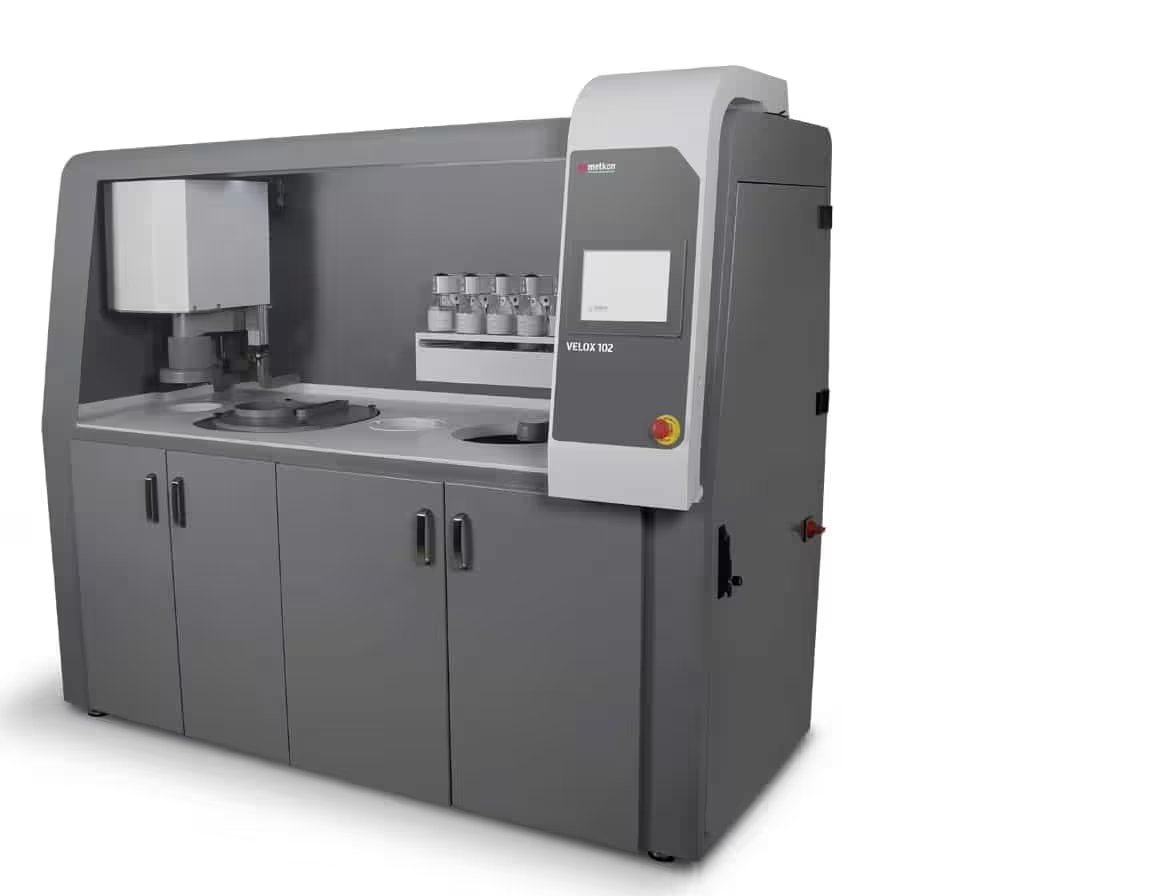
The best prep technology is fully automatic metallographic grinding machines. Their recipes have saved everything in order to control each variable and optimize specimen-to-disk pressure, rotation speed, lubricant flow, cycle time and so on. Full metallographic operations can be performed without directly contacting the machine at high-volume labs, where operators simply set the parameters and launch the machine. With these systems, prep time is reduced from 1-2 hours to just 25-45 minutes, which means labs can handle 60% more work. The advanced models such as the Velox 102 Series help to gain features like switching between central and individual force application as needed.
Key Features to Compare Before Buying
You need to evaluate technical specifications when comparing metallographic grinding machines for your laboratory. These features directly affect performance, precision, and overall value.
Wheel size and speed range considerations
The wheel diameters range from 200mm up to 350mm. Bigger platens support larger samples up to 50mm in diameter. Some models have greater speed control capacity. Basic units don’t have much, though. Sophisticated systems provide adjustable speed points of 50-600 rpm at specific increments. High-torque motors from 0.75 kW to 4 kW deliver consistent operation even under challenging conditions. Wheel speed is an important component of material-specific preparation, as different materials will require different grinding velocities for the best results.
Force application: Individual vs central force heads
Mechanisms of force application exist in two principal classes, namely individual and central. Force systems apply separate pressure to each specimen (generally 5-90N per sample). So they are the most suitable for mixed or delicate materials. Central force systems distribute uniform pressure across multiple samples at once (30-750N total). This maintains constant surface finish and provides improved edge stability for harder materials. A good few state-of-the-art machines provide both, so labs can alternate between approaches based on their needs.
Cooling systems and water rinse integration
The fastest way to avoid thermal damage in grinding is by good cooling. The system is fully activated and deactivated for accurate temperature regulation at both turning on and off the cycle by the automatic switching of the water. Harder materials do require advanced cooling systems, to keep microstructural integrity and avoid thermal artifacts. Some systems will also possess cleaning stations with air, water, and ethanol as cleaning agents for multi-step cleaning of specimens.
Programmable controls and touchscreen interfaces
Contemporary metallographic grinding machines include easy to use interfaces. These may be from simple membrane controls to sophisticated 7-inch colored HMI contact screens. The advanced models have the ability to store methods for consistent sample preparation among operators. Programmable interfaces that control wheel speed, pressure, rotation direction, and cycle duration are among important parameters for the system. High-end models provide LAN connections for remote monitoring and maintenance.
Metallographic Sample Preparation: Expert Guide to Perfect Specimens
Compatibility with polishing accessories
The versatility of equipment drastically increases with compatibility of accessories. The main team is examining specimen holder compatibility (from single mounts to multi-sample holders) and automated dispensing systems. Newer models connect to as many as six dispensing units interfaced via the main interface. Machines equipped with vacuum and magnetic disk mounting systems provide users greater flexibility in how to prepare the process.
Conclusion
The selection of the metallographic grinding machine is a matter of matching your requirements with your budget. In this piece, we examined equipment from basic manual grinders to next generation automated machines and the impact these have on specific labs. Most schools benefit from low-cost manual or semi-automatic tools. The aerospace and biomedical industries prefer high-precision systems with sophisticated controls. Technical specifications must guide your choice. Differences in wheel size, speed range, mechanisms of force application, and cooling systems directly impact preparation quality and speed. Additionally with programmable interfaces and accessory compatibility, the equipment is more flexible for different materials and methods. Labs should consider more than the initial purchase cost.
They should review the whole operating cost — which comprises consumables, maintenance and potential savings via automation. Choosing the right metallographic grinding machine certainly is a crucial investment and research outcome and lab throughput will be impacted if a laboratory decides how best to run the machine. Review your sample volume, material types, precision needs, and budget limits before making your determination. The right equipment will deliver reproducible, high-quality output and should work well with your existing workflow. Sample preparation is the bedrock of an accurate microstructure analysis. That means your choice of grinding machine is crucial for research success.


