
Metallography Consumables: Expert Tips for Better Surface Finish Results
Metallography Consumables: Expert Tips for Better Surface Finish Results
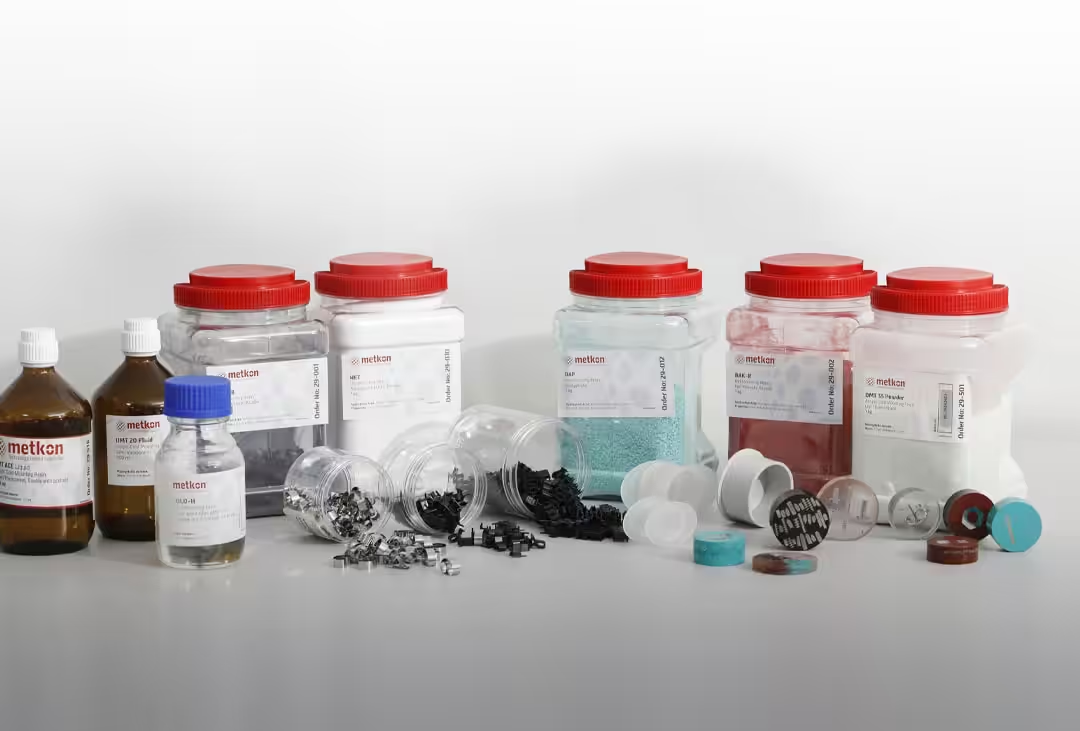
The quality and precision of your results largely depend on the quality of your Metallography Consumables, something that even the best equipment cannot compensate for, when preparing metallographic specimens. Cutting discs, mounting resins, grinding papers, and polishing cloths all play a crucial role in this process and getting them right can take an average surface finish to an exceptional one, and that is exactly what Metkon provides.
Our grinding papers and polishing solutions come to mind for achieving an incredibly smooth, flawless finish, and produce consistent outcomes every single time. It is because of our expert advice in this domain, it can improve your specimen preparation and lead to results like diamonds in your rough stones. With superior surfaces, for metal specimens in regular manufacturing work, or rock and mineral specimens.
Choosing the Right Metallographic Consumables for Reliable Analysis
The materials used, often referred to as metallographic consumables, come into contact with the specimens to give an accurate view of their microstructure, when preparing samples for analysis. A multi-step process is required, in which the accuracy of the analysis is built on each one of the techniques executed in sequence.
This begins with cutting the specimens using abrasive wheels containing aluminum oxide or silicon carbide, to accurately section and prevent deformation. Diamond wafering blades are, however, the preferred method to cut very delicate and intricate materials such as electronics or composites, ensuring that they remain intact. The procedure then proceeds to encapsulate, in a non-damaging manner, with soft compounds, for instance, or else render the specimens simpler to handle.
A choice between hot mounting and cool mounting techniques is made with regards to whether to use thermosetting resins, such as phenolic and epoxy or thermoplastics, methyl methacrylate and high-pressure heat, and or the much simpler epoxy and acrylic cold mounting systems. Silicon carbide papers then help eliminate sectioning damage and perfectly level out the specimens, they’re essentially self-sharpening, which allows for quick removal of material, alumina papers though, are better for super soft materials, because they don’t crack so easily. After that, you finish off the surface with polishing cloths and fine abrasives. Diamond abrasives on flat cloths provide the perfect surface flatness in the rough polishing stage, but once you need to give a mirror finish, you turn to softer napped cloths with alumina or colloidal silica.
Rockwell Hardness Testing: Essential Guide for Quality Engineers
When discussing achieving the best metallographic results, precise control over preparation parameters is basically a necessity. Here are eight metallography consumable usage tips that can be used to boost the effectiveness of your preparations, and are backed up by extensive testing and research.
8 Expert Tips for Right Metallography Consumables
1. Pressure Control During Grinding
When grinding, using the pressure of the grinding wheel is the key to getting the desired result. Too much pressure and you’ll get wear and tear, not to mention unpleasant by-products, and too little pressure will result in uneven surfaces and a snail’s pace of progress. Coming at it with fair and consistent pressure, balancing the speed of material removal with the quality of the surface is really the best way to go.
2. Specimen and Grinding Paper Velocity
In the case of grinding and polishing specimens on a lapidary wheel or polishing wheel, the relative speed between the wheel and the paper is what matters most. Coming at the wheel too quickly will make it spin faster, but might ruin the surface, on the other hand, going slow will make it take ages to grind or polish, but gives you more accuracy. Well-known is the sweet spot for diamond polishing, where the platen RPM falls between 150 to 180, but beyond that speed, doesn’t really see much increase in the amount of material being removed.
3. Cross-Grinding Method
Use cross-grinding methods by changing the direction of grinding for each stage. It avoids directional artifacts and creates an even surface. It is possible to check for full scratch removal by rotating specimens 90 degrees between stages.
4. Choosing the Proper Polishing Cloth
It’s key to use the right type of cloth that’s in line with the material properties of what you’re polishing, when polishing. Hard, napless cloths are generally ideal for engineering materials, and medium-napped cloths are suitable for intermediate stages. Finishing touches can be achieved with high-napped cloths. The hardness of your specimen, on the other hand, should be in sync with the fabric you’re using, so that soft materials don’t get scratched by rough cloths, and hard materials don’t slip off too easily.
5. Coolant Flow Rate
You should ensure that the coolant is present in adequate amounts to prevent heat damage to the tool and the workpiece, when machining. If the coolant flow is not sufficient, the heat generated during the process will cause the microstructure of the workpiece to change, it will introduce smearing and also wears away the abrasives much faster. For soft to medium-hard materials which have a hardness of 75 to 500 HV, a coolant flow of two to four liters per minute is recommended, and four to six litres per minute is best for the harder materials.
6. Selecting the Right Diamond Abrasive
Select diamond abrasive strategically. Polycrystalline diamonds sharpen their components and can remove materials much faster. Monocrystalline diamonds provide softer and more orderly polishing. High-viscosity suspensions aggressively isolate material, while low-viscosity formulations are better controlled for delicate samples.
7. Cleaning Between Stages
Give the surface a good clean to avoid cross-contamination, when moving from one stage of the preparation process to the next. Ultrasonic cleaning is perfect for scrubbing away embedded abrasive residue, it can get into the tiny pores and crevices. Cleaning between preparation steps is also a must, because if the coarse materials from the previous stage are allowed to move forward, they may scratch the surface in the following steps.
Automated Sample Preparation | Cut Impact, Save Time & Costs
8. Lubrication Balance
Give the surface a good cleaning to prevent cross-contamination, when moving from one stage to the next in the cleaning process. Ultrasonic cleaning is very good at dislodging abrasive particles that are trapped in the tiny crevices and pores of the surface, and cleaning the surface between preparation steps also stops coarse material from scratching the surface when you get to the finer stages.
As for metallography, the use of high-quality consumables is what makes all the difference in the accuracy and reliability of material analysis. A good cutting disk, mounting resin, grinding paper and polishing cloth can transform the surface of your samples into a much clearer and more workable state.
While labs may have a tendency to view these consumables as disposable, labs who take the time to select, store, and manage these essential supplies tend to enjoy better results in metallographic analysis. A systematic procedure for metallographic preparation comprises of accurate cutting, then mounting, grinding and polishing, all in an ascending chain, with a consumption of the necessary supplies at each stage. Nothing else will do, since each stage relies on the quality of the last.
To make sure, choose consumables that are suitable for the material you are working with. This can be seen as an easy but important task. For you to get the best results, eight hard-hitting tips have been developed to get rid of mistakes in analysis and help speed up the whole procedure. Success in metallography can be assured with mastered pressure management, fine-tuning of velocity and crisscross grinding.
The best polishing cloths, moderate use of coolant and appropriate diamond abrasives make it possible to combat surface problems that can cause irregularities. Samples that have been badly prepared can throw off your analysis, and this is averted by cleaning the samples and hitting the balance between lubricant and friction.
Well-kept tools, much like good quality consumables, are equally important in the long term performance. Logging the usage, storage environment and rating of each piece is the secret to an efficient lab and consistent results, and by doing so, cuts down waste and gives accurate analysis.
If you want to get great metallographic results, start with quality consumables but also don’t forget to apply sound techniques. Smoother, more accurate and consistent results are guaranteed and show the genuine microstructure of your sample free of any preparation artefacts.
FAQs about Metallography Consumables
Q1. What are the factors that are important in choosing the appropriate metallography consumables?
Several variables at the sample preparation stage can make a huge difference in the accuracy of the results, when preparing a sample for analysis. This is where material analysis, surface finishing and abrasive, resin, grit, and cloth textures come into play. Basically the abrasive type used in cutting disks, the properties of the resin used for mounting, the size of the grit in grinding papers and the texture of the cloth used for polishing all contribute to the quality of the sample.
Q2.How can I prevent thermal damage during the cutting process?
Use water-cooled cutting to minimize heat damage. This technique helps maintain the specimen’s microstructure integrity by preventing unwanted alterations due to excessive heat buildup during the cutting process.
Q3. How best to grind metallographic samples?
You’ll want to move from coarse to finer grits, when grinding a sample. Coming at it this way is essentially the most efficient way to remove material, but it also helps in getting rid of deep scratches. Fresh grinding paper is necessary to prevent the surface from being grooved, and you’ll get the best results by rotating the sample 90 degrees between each stage.
Q4. How do I select the appropriate polishing cloth suitable for my samples?
Consider the finish you want, when selecting a polishing cloth. For the first step of polishing engineering materials, hard, napless cloths are a great choice. Medium-napped cloths are suitable for intermediate polishing and can produce the best results in the second or third step, and high-napped cloths, with their fine structure, are perfect for the final finish. The hardness of your specimen also has to be in sync with the cloth you’re using, or the polish won’t be effective.
Q5. How to maintain metallography consumables well?
Keep them upright and in dry, temperature-controlled environments, when storing cutting wheels. Polishing cloths are best rolled rather than folded to prevent creases. Sandpaper, on the other hand, is optimally stored flat in dark and dry areas. Coming hotfooting back to check individual parts before swapping out entire sets is also a good idea, and remembering the previous usage status is pretty important in order to ensure the quality of the consumables. Consumables, by their very nature, have a long shelf life and this makes them even more reliable and hardy if kept in good condition.


