
What is Brinell Hardness Test?
What is Brinell Hardness Test?
The Brinell hardness test is still one of the most reliable and accepted methods of measurement of material hardness in engineering. This basic testing protocol was developed over a century ago and is utilized in almost every manufacturing facility and remains the backbone of the quality control system. Brinell testing is used with considerable reliability in the decision-making process especially on castings, forgings, and heterogeneous structures of materials by engineers. The procedure is very simple, where a ball of hardened steel or tungsten carbide is pressed into the surface of a material under controlled conditions, then measuring the resulting indentation. Yet, obtaining precise and reproducible results necessitates appropriate application and knowledge of test parameters.
Rockwell Hardness Testing: Essential Guide for Quality Engineers
Additionally, determining between the Brinell method and other hardness tests might have a much greater contribution on the precision of the accuracy of material evaluation. This book will guide to familiarize you with the complete Brinell hardness test procedure, setting up equipment and the arrangement of the test set up and end results and its interpretation and use. So you might be new to materials testing or have something specific to improve on when you need to practice this life-saving engineering skill.
Understanding the Brinell Hardness Test Setup
Proper equipment setup forms the foundation for accurate Brinell hardness measurements. The test configuration consists of three critical components: the indenter material, applied force, and the relationship between these parameters.
Tungsten Carbide vs Steel Ball Indenters
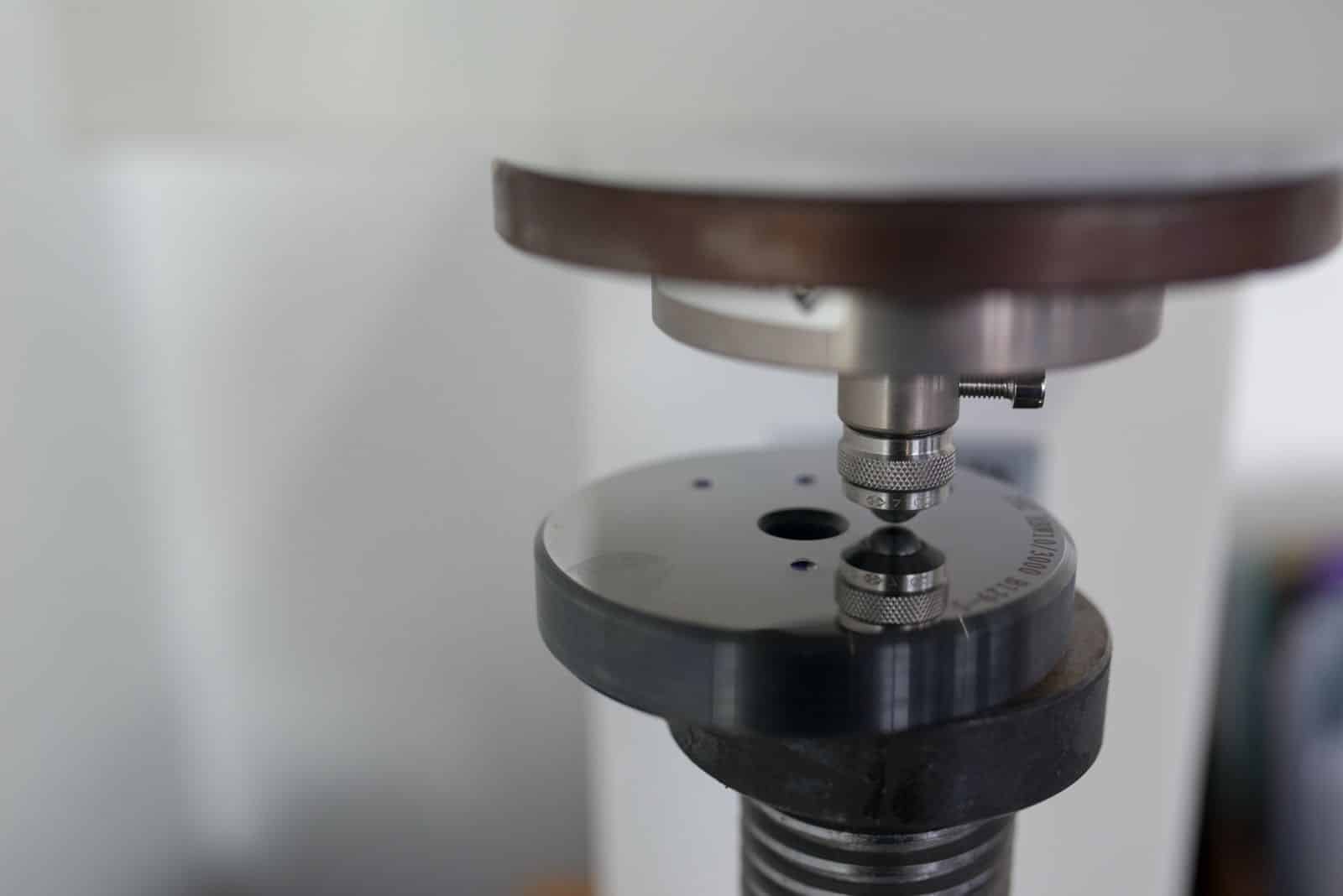
Contemporary Brinell testing consists of tungsten carbide ball indenters rather than hardened steel balls. This material choice directly influences both the measurement accuracy and the materials that can be tested as well. Tungsten carbide indenters are available in four standard diameters: 1mm, 2.5mm, 5mm, and 10mm. It is a matter of choice of material tested and indentation size required. For many years, hardened steel balls were used (HBS), but now using tungsten carbide (HBW) has supplanted the original steel as standard due to its superior hardness and wear resistance. Hardened steel balls are also adequate when testing products up to 444 HBW. For harder materials up to 627 HBW, tungsten carbide balls are required to avert indenter deformation. To be sure, very hard metals with over 450 HBW would deform their steel balls, causing an inaccurate reading.
Standard Load Ranges: 500–3000 kgf
The Brinell method encompasses a wide test load range from 1 to 3000 kgf. Most commonly, forces between 500–3000 kgf are applied, with the specific selection depending on the material:
- 500 kgf: Typically used for testing non-ferrous and softer metals such as aluminum and copper alloys
- 3000 kgf: Standard for testing harder materials like steel and cast iron
The load is applied for a specific duration – 10 to 15 seconds for hard ferrous materials and approximately 30 seconds for soft, non-ferrous materials. This time period ensures plastic flow of the material has ceased, producing stable indentation measurements.
Ball Diameter and Load Ratio (F/D²)
The relationship between test force (F) and ball diameter (D) is crucial for obtaining comparable and accurate results. This force-diameter ratio, expressed as B = 0.102 × F/D², must remain constant within a testing method.
Five standard force-diameter ratios exist: 1, 2.5, 5, 10, and 30 78. The most common configurations include:
| Material Type | Typical F/D² Ratio |
|---|---|
| Steel/Cast Iron | 30:1 (e.g., 10mm ball with 3000 kgf) 4 |
| Aluminum Alloys | 5:1 4 |
For optimum accuracy the test load should be required to generate an indentation diameter between 0.24D < d < 0.6D where D is the ball diameter, D. Therefore, tests are done with balls of different diameter, but at the same F/D² ratio will give similar hardness values. Test results cannot however, be compared directly as they are at different force or diameter ratios. Consequently, testing of a material of several different ball diameters and forces must have the same force-diameter index to achieve similar results. This one-size-fits-all approach enables the Brinell method be extremely practical, allowing for materials that vary from soft non-ferrous metals to hardened steels to include in the test. Furthermore, because the indentation size is relatively large, it is particularly useful in the testing of materials with heterogeneous structures, e.g. castings and forgings, as local variation may affect other hardness testing techniques.
How to Perform a Brinell Test Step-by-Step
Executing a precise Brinell hardness test requires methodical preparation and attention to detail at each step. While the concept appears straightforward, consistently obtaining accurate results demands strict adherence to established protocols. Let’s examine each phase of the testing procedure.
Surface Preparation and Sample Thickness
The specimen surface should be adequately prepared before testing. First, clean the place where the indentation will occur and eliminate impurities that might influence results. The area (which can be filed, ground, machined, or polished flat) will be prepared using suitable abrasive materials to clearly delineate the indentation edge and thereby allow for proper measurement. During this preparation, consider any changes to hardness of the surface of the material, and be extremely mindful to avoid overheating or cold-working, otherwise the material properties in an artificial manner might be altered.
What is the Vickers Hardness Test? | Method, Applications & Advantages
Testability is also determined by the sample thickness. The material should be thick enough to avoid any visible deformation on the opposite side upon indentation. ISO standards state that the specimen is expected to be a minimum of eight times thicker than the indentation depth and ASTM standards specify a minimum of ten times the indentation depth. The specimen must not be too thin: if the specimen is too thin, a hardness reading will be incorrect due to the impact of the support surface on these testing results. Make sure to align the specimen parallel to the support platform before starting, with firm clamps between the support platform and where the specimen is to be measured to restrict vibration or shocks that would affect the readings.
Load Application Time (10–30 seconds)
Once the specimen is properly positioned, the next phase involves applying the test load. According to ISO 6506, increase the test load to its final value within 2-8 seconds. The standard dwell time (duration under full load) ranges from 10-15 seconds for most materials. For softer materials, 10-15 seconds is typically sufficient, while harder or thicker materials may require up to 30 seconds.
This dwell period serves a specific purpose—it ensures that plastic flow of the metal has completely ceased, resulting in a stable, measurable indentation. If the dwell time exceeds the standard range, you must specify the duration in seconds when reporting the hardness value (e.g., 210 HBW 5/250/30 for a 30-second dwell time).
During load application, avoid creating any vibrations that might reach the testing machine, as these could affect the indentation formation.
Indentation Measurement Using Optical Devices
After removing the load and withdrawing the indenter, the final step involves measuring the resulting indentation. Traditionally, this measurement was performed manually using a low-power microscope, requiring technicians to visually identify the indentation edges—a process prone to operator interpretation errors, where a 0.2mm discrepancy could equal 20 hardness points.
Modern testing typically employs automated optical measurement systems that offer significantly improved accuracy and efficiency. These systems capture digital images of the indentation and use advanced algorithms to precisely determine the indentation diameter.
For proper measurement:
- Measure the indentation diameter in at least two directions perpendicular (90°) to each other
- Calculate the arithmetic mean of these measurements to determine the Brinell hardness number
Automated systems like BrinScan can measure over 200 points around the indentation circle, providing results in less than one second compared to the two minutes typically required for manual measurement. These systems also eliminate transmission errors common in manual processes, automatically saving measurements and generating hardness test reports .
For large indentations, notably, even if only half the indentation appears in the measurement field, automated systems can still accurately calculate the hardness value .
Calculating Brinell Hardness Number (HBW)
Once the indentation has been created and measured, calculating the actual Brinell hardness number transforms raw measurements into meaningful material data. The mathematical relationship between test parameters yields a standardized value that engineers worldwide can interpret consistently.
HBW Formula: 0.102 × 2F / πD(D – √(D² – d²))
Converting indentation measurements to the Brinell hardness number requires a specific formula that accounts for indenter size, applied force, and indentation diameter. The standard equation as defined by ASTM E10-14 and ISO 6506-1:2005 is expressed as 1:
HBW = 0.102 × 2F / πD(D – √(D² – d²))
Where:
- F = applied force in newtons
- D = diameter of the indenter ball in millimeters
- d = mean diameter of the indentation in millimeters
The constant 0.102 converts the force from newtons to kilogram-force when using SI units 1. The equation effectively divides the test force by the curved surface area of the indentation, resulting in a pressure value that represents material hardness.
After calculating the Brinell hardness value, it must be reported in a standardized format. For instance, “250 HBW 10/3000” indicates:
- 250: The hardness value
- HBW: Tungsten carbide ball indenter (W from “Wolfram”)
- 10: Ball diameter in millimeters
- 3000: Force applied in kilogram-force
Using Conversion Tables for Quick Results
Although the mathematical formula provides precise results, engineers often use standardized conversion tables for efficiency. These tables eliminate manual calculations by allowing technicians to simply measure the indentation diameter and look up the corresponding hardness value.
Conversion tables exist not only for calculating Brinell hardness but furthermore for translating between different hardness scales, including Rockwell, Vickers, and Knoop scales. Nevertheless, such conversions must be used cautiously since they are approximations based on empirical relationships between testing methods that measure different material properties.
Common Errors in Manual Measurement
Despite the formula’s precision, measurement errors remain a significant concern in Brinell testing. Manual measurement presents several challenges:
- Edge Definition Uncertainty – Determining exactly where an indentation edge begins can be subjective, as the indentation process creates material “pile-up” around the rim. A mere 0.2mm discrepancy in diameter measurement can result in a 20-point hardness difference.
- Operator Interpretation – Three experienced technicians might provide three different readings for the same indentation 7. This variability historically led some to consider the Brinell test less precise than other methods.
- Reading Limitations – ASTM E10 specifies that handheld microscopes with fixed measuring lines (Type B devices) cannot be used for measuring indentations made with 2.5mm and 1mm ball indenters.
Automated measurement systems address these challenges through digital imaging technology that precisely defines indentation boundaries. These systems can measure hundreds of points around the indentation circle in under one second, vastly improving both accuracy and efficiency compared to the two-minute process typical of manual measurement.
Brinell Test Standards and Material Guidelines
International standards govern all aspects of Brinell hardness testing, ensuring consistent results across different laboratories and testing equipment. Mastery of these standards remains essential for engineers conducting materials evaluation.
ASTM E10 and ISO 6506 Overview
Two primary standards regulate Brinell hardness testing worldwide: ASTM E10 and ISO 6506. The American Society for Testing and Materials (ASTM) E10 provides comprehensive requirements for testing machines, procedures, and verification methods. Meanwhile, ISO 6506 consists of four parts covering test methods (Part 1), machine verification (Part 2), reference block calibration (Part 3), and hardness value tables (Part 4). Both standards specify similar testing principles yet differ slightly in procedural details.
For equipment verification, ASTM E10 requires Class AA elastic force measuring instruments with at least 0.05% accuracy 16. Similarly, ISO 6506-2 mandates both direct verification (checking individual machine parameters) and indirect verification (using reference blocks) to ensure testing accuracy.
Hardness Testing Explained: From Basic Methods to Expert Techniques
Material-Specific Load and Ball Combinations
Brinell testing accommodates approximately 25 different load/ball combinations, enabling testing across virtually all metals. The five standard force-diameter ratios are 1, 2.5, 5, 10, and 30. Importantly, tests with load/indenter combinations having identical ratios produce equivalent hardness values, whereas tests with different ratios cannot be directly compared.
When reporting results, always include the complete designation: hardness value followed by HBW symbol, ball diameter (mm), and test force (kgf) – for example, “450 HBW 10/3000”.
Minimum Thickness and Indentation Diameter Rules
Specimen thickness must be sufficient to prevent bulging on the opposite side. ISO 6506 requires material thickness at least eight times the indentation depth, whereas ASTM E10 specifies ten times the indentation depth.
Regarding spacing requirements, both standards mandate specific minimum distances between indentations. The distance between centers of adjacent indentations must be at least three times the indentation diameter, plus the distance from any indentation center to a specimen edge must be at least two and a half times the indentation diameter.
Applications and Limitations in Engineering Practice
Engineering professionals select the Brinell hardness test based on specific material properties and testing requirements. Understanding both its strengths and limitations guides proper application in industrial settings.
Use in Castings, Forgings, and Coarse-Grain Metals
The Brinell test excels with non-homogeneous materials like castings and forgings because its large indenter creates an impression across multiple crystals, forming a mechanical average hardness value. This makes it ideal for materials with coarse grain structures or rough surfaces where other methods would yield inconsistent results. Steel and iron castings generally undergo testing with a 3000 kg force and 10 mm ball, aluminum castings with 1500 kg, plus copper and brass with 500 kg. Industries including automotive, heavy machinery, and oil and gas rely extensively on this method for quality assurance of large components.
When Not to Use Brinell: Thin or Hardened Materials
Conversely, the Brinell method presents limitations. It proves unsuitable for very thin specimens due to its deep penetration requiring minimum thickness requirements. Testing fully hardened steel becomes problematic as the test range is narrower than Rockwell or Vickers methods. Moreover, curved surfaces present challenges since the test needs flat testing areas 23.
Comparison with Rockwell and Vickers Tests
But unlike Brinell, Rockwell testing provides faster results and can perform on small, machined components but fails on coarse surfaces. Its optical system gives the Vickers test great precision and is suitable for measuring microstructures and thin materials though surface preparation is required beyond what may be expected. So, you should know everything that happens in order to actually master the Brinell hardness test, your testing process, the correct tool to use and what to make of the results you receive.
It is especially appealing for materials with heterogeneous structures like castings and forgings, where its large indentation size yields reliable averages among distinct grain structures. Engineers need to be mindful of the fact that accurate results are made on those surfaces, the proper selection of ball size and load ratio as well as accurate measurement instruments. Furthermore, following international standards, such as ASTM E10 and ISO 6506, provides consistency of the tests in different laboratories and facilities.
Metallographic Sample Preparation: Expert Guide to Perfect Specimens
Test results are virtually comparable internationally based on identical force-diameter ratios used with a standardized approach. Although manual methods of manual measurement were often hindered by operator interpretation errors, automatic optical measurement systems have drastically improved both efficiency and accuracy. Brinell test is excellent with any rough and non-homogeneous material but other testing methods are appropriate according to your requirements. For microstructures and thin specimens, Rockwell test provides faster results than Vickers test, but Vickers gives the most accurate results on a smaller machined part. Knowing the differences helps engineers choose the most suitable testing method for the target application.
There are few books prepared or published about accuracy, validity, or mechanical properties, so this practical handbook will provide you with the basic background required to accurately demonstrate Brinell hardness testing. These skills range across a range of tasks from assembly, surface preparation, and measurement to result calculation and evaluation, and represent an essential element of materials assessment in contemporary engineering. By applying these concepts thoughtfully, you are assured of obtaining information about properties, keeping quality parameters in check and allowing you to make sound choices on materials selection and material treatment.


