
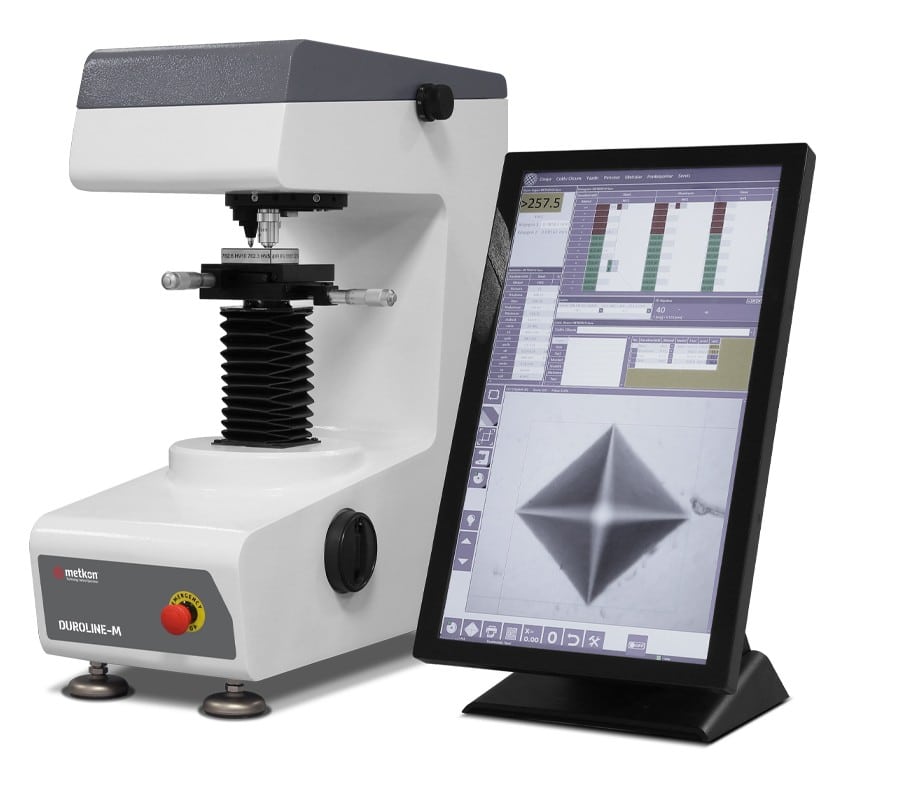
What is the Vickers Hardness Test? | Method, Applications & Advantages
What is the Vickers Hardness Test? | Method, Applications & Advantages
The Vickers hardness test was created in 1921 by George E. Sandland and Robert L. Smith of Vickers Ltd. One of the most versatile hardness testing techniques available today is this test. With one of the most comprehensive hardness testing scales available, it was developed as a substitute for the Brinell method and is currently applicable to all metal types. The test is very easy to use because its computations are independent of the indenter size. Technicians can precisely measure the distinct indentations produced by an inverted pyramid-shaped diamond indenter. With testing loads ranging from 10 gf to 100 kgf, the test’s versatility is evident. We can test softer materials like 316L stainless steel (140HV30) and harder ones like diamond (10000HV) in this range. Additionally, it doesn’t destroy the samples, so after testing, you can use them once more. Compared to other approaches like Rockwell, the process is slower, taking roughly 30 to 60 seconds per test. However, the accuracy provided by the Vickers hardness formula makes the additional effort worthwhile. Let’s examine every aspect of this important materials testing technique. We’ll go over its background, operation, applications, and unique features.
Origins and Design of the Vickers Hardness Test
The Vickers Hardness Test’s History and Design Smith and Sandland developed it in 1921. The Vickers hardness test was developed as a result of British engineering innovations. This groundbreaking hardness testing technique was developed in 1921 by two engineers at Vickers Ltd., Robert L. Smith and George E. Sandland. The limitations of material testing at the time were explained by their engineering background. This knowledge inspired them to create a more adaptable substitute for current techniques.

Brinell will be replaced in order to conduct more extensive material testing. The primary objective of Smith and Sandland was to get around the material restrictions of the Brinell method. The Brinell test was insufficiently adaptable to various hardness ranges, but it performed well for some materials. With a range of materials, their approach produced more reliable results. An enormous benefit over previous approaches was that they created a test in which computations remained independent of indenter size. This made the Vickers test more widely applicable. Because of their design, engineers could test materials with varying degrees of hardness using the same tools and techniques.
Rationale for diamond pyramid indenter geometry
The indenter design of the Vickers test is a brilliant example of engineering. After considering their options, Smith and Sandland chose a diamond with a square base pyramid shape. Three main characteristics made this shape unique: the diamond material resisted self-deformation exceptionally well; the impression had distinct, well-defined measurement points; and it produced geometrically similar impressions of any size.
The Ultimate Guide to Grinding and Polishing: Techniques, Equipment, Materials, and Best Practices
The 136° angle between opposing faces on the pyramid wasn’t arbitrary. This angle was calculated by engineers using the best impression size found in the Brinell test, which is roughly 3/8 of the ball diameter. At precisely 136°, two tangents to a circle at the ends of this chord intersect. As a result, each face normal to the horizontal plane forms a 22° angle.
Experiments by Smith and Sandland demonstrated the effectiveness of their design. They provided unambiguous evidence of the mathematical accuracy of their design by demonstrating that hardness values remained constant on uniform materials regardless of the load applied.
What is Metallography? Definition, Techniques &; Industrial Applications
Vickers Hardness Formula and Measurement Process
Compared to other hardness testing techniques, the Vickers test is unique. Instead of using depth to determine hardness, it uses the surface area of the indentation. Results from this method are consistent across all kinds of materials.
- HV = 1.8544 × F / d² is the Vickers hardness formula
The foundation of the Vickers hardness test is the mathematical formula. The applied force (F) divided by the diamond indentation’s surface area (A) yields the hardness value. The full formula is as follows:
- HV = F/A ≈ 1.8544 × F/d²
D is the average length of the two diagonals of the indentation in millimetres, and F is the force applied in kilogrammes-force (kgf). The geometric relationship A = d²/(2sin(136°/2)), which reduces to A ≈ d²/1.8544, is the source of the constant 1.8544.
- Units: conversion of kgf/mm² to MPa
Vickers hardness values, which represent kgf/mm2, typically do not include units. These values frequently need to be converted to megapascals (MPa) by scientists. This is how the conversion operates:
To convert HV to MPa, multiply by 9.807
- 9.80665 MPa is equal to 1 kgf/mm².
- The hardness of a material with 100 HV would be roughly 980.7 MPa.
Common notation, such as 440HV30/20
The standard notation format for the Vickers hardness results is xxxHVyy or xxxHVyy/zz. Let’s dissect this:
xxx: the value of numerical hardness
“Hardness Vickers” is indicated by HV.
yy: the applied test load in kgf
zz: the optional dwell time in seconds, which is added when it deviates from the typical range of 10 to 15 seconds
When tested at 30 kgf, 440HV30 displays a hardness value of 440. The same test with a 30-second dwell time is indicated by 610HV10/30.
Diagonal length measurement using optics
Accurate indentation measurement is essential for the Vickers hardness test. After applying load, the square impression’s two diagonal lengths are measured using an optical microscope. Since the base area of the Vickers indents rarely forms a perfect square, both diagonals require measurement. The average of these measurements is used to calculate hardness.
For accurate readings, standards demand a minimum diagonal width of 20 μm. Compared to other hardness tests, this optical measurement method takes longer, but the results are consistent and dependable.
Testing Standards and Indentation Guidelines
Accurate and trustworthy Vickers hardness results can be obtained with the proper testing methods. ASTM E384 and ISO 6507 are the two primary standards that govern these processes. Every standard has unique requirements.
ASTM E384 vs. ISO 6507-1 spacing guidelines
An important factor is the distance between indentations. Any influence from work-hardened areas created by earlier tests must be avoided. ASTM E384 and ISO 6507-1 have different minimum distance requirements:
- Indentations must be spaced apart by:
For steel and copper alloys, ISO 6507-1 requires at least three times the diagonal length; for light metals, lead, and tin, it is six times. ASTM E384: At least 2.5 times the length of the diagonal
From the edge of the specimen to the indentation centre:
- ISO 6507-1: Copper and steel must be at least 2.5 times the diagonal; light metals must be three times.
- ASTM E384: At least 2.5 times the diagonal
By following these spacing guidelines, distortion from material deformation around indentations is less likely to occur.

Minimum indent size and sample thickness
The thickness of a specimen has a direct impact on measurement accuracy. According to standards, the minimum thickness must be at least 1.5 times the diagonal length of the indentation. This rule ensures that there is sufficient material to appropriately limit deformation.
The thickness of the majority of specimens falls between 0.085 mm and 6.5 mm. Results are greatly impacted by surface preparation. Specimens should be polished or ground, particularly when test loads are lower and the indentations are smaller.
For accurate readings, the diagonal width must be at least 20 μm. To reduce the possibility of distortion, the maximum force should be applied.
Microstructure influence and the indentation size effect (ISE)
When measured hardness rises as indentation size decreases, the indentation size effect (ISE) becomes apparent. At lower loads (0.01-0.2 kgf), this effect becomes evident.
ISE occurs for a number of reasons:
- During indentation, strain hardens
- After unloading, elastic recovery
- Movement and dislocation density
The microstructure of a material influences its hardness values. Results can vary depending on grain boundaries, phase distribution, and past deformation history, particularly for smaller indents. For representative hardness values, indents must be sufficiently large to average across microstructural features.
With hardness plateauing at higher forces, advanced ceramics exhibit ISE more clearly. This demonstrates the importance of standardised testing forces when comparing the hardness of various materials.
Applications and Material Comparisons
Examining the Vickers hardness test’s numerous applications in materials science and engineering reveals its true worth.
Hardness values for diamond, martensite, steel, and iron
Both soft and hard materials can benefit from the remarkable range covered by the Vickers hardness scale. Carbon steel exhibits hardness values ranging from 55 to 120HV5, whereas iron displays values between 30 and 80HV5. Tool steel has a 700–1000 HV range, while martensitic stainless steel usually has a 450–800 HV range. Martensite has a height of roughly 1000HV. The hardest substance in nature, diamond, is at the top of the scale with an astounding 10,000HV. The Vickers method is an excellent way to obtain material comparison and quality control data because of this broad range.
Use in Jominy, CHD, and weld testing
When measuring case hardness depth (CHD), the Vickers test is an excellent tool. By making an indentation series from the edge inward, you can evaluate surface-hardened steels. CHD displays the distance from the surface to the hardness limit of 550HV for carburized parts. The Jominy end-quench test measures the hardness along a quenched specimen using Vickers measurements to determine whether steel is hardenable. Another important application is weld testing, particularly in the heat-affected zone. In order to avoid hydrogen cracking, welds must remain below 380HV. To avoid sulphide stress corrosion, welds that come into contact with sour products are subject to a more stringent limit of 248HV.
Tensile strength estimation using HV values
One of the most helpful aspects of this test is its ability to estimate tensile strength from hardness measurements. The ultimate tensile strength of carbon steels can be calculated by multiplying their Vickers hardness by approximately 3.3. This partnership facilitates rapid quality control inspections without compromising the content. This relationship is expressed by the formula σᵤ ≈ HV/c, where c varies from 2 to 4 depending on the material properties. Tensile strength (MPa) ≈ HV/3 when HV is in MPa because a common shortcut uses c=3. This correlation is adequate for many industrial applications, despite its imperfections.
Since its creation in 1921, the Vickers hardness test has demonstrated its value in engineering. This article demonstrates how this adaptable approach outperforms alternative hardness testing methods. Its ability to provide consistent measurements for all kinds of materials—from diamond at 10,000HV to soft metals at 30HV—is without a doubt its best feature.
With its mathematical accuracy, the Vickers formula (HV = 1.8544 × F / d2) functions flawlessly. It is dependable at various scales because test results remain unaffected by indenter size. Despite taking longer than Rockwell testing, the Vickers method is essential to materials testing because of its dependability.
By establishing precise guidelines for sample preparation, spacing requirements, and measurement procedures, standards such as ISO 6507 and ASTM E384 have improved the procedure. Under various circumstances, these standards assist labs worldwide in obtaining consistent results.

Vickers testing is not limited to measuring hardness. With extreme precision, engineers use it for Jominy end-quench testing, weld quality testing, and case hardness depth checks. By connecting Vickers hardness to tensile strength without destroying samples, it also aids in the estimation of mechanical properties.
Although other hardness tests may be quicker, Vickers offers the ideal mix of precision, adaptability, and dependability. These characteristics account for its continued relevance after more than a century. Materials scientists, metallurgists, and quality control experts still use this technique, perpetuating Smith and Sandland’s contribution to materials science and engineering. Metkon supports your material testing needs with reliable and precise Vickers Hardness Testing solutions. Designed for accuracy, efficiency, and ease of use, our systems help ensure consistent quality control and dependable results in your laboratory or production environment.
AI Summary
For readers who want a quick and structured understanding of the Vickers Hardness Test, an AI-generated summary is provided here. This summary highlights the fundamental principles of the test, its measurement method, and its common applications, allowing you to grasp the key concepts without reviewing the full article.
FAQ about Vickers Hardness Test
What are the main advantages of the Vickers hardness test?
From diamond to soft metals, the Vickers hardness test provides reliable readings for a variety of materials. It is dependable on a variety of scales because its results are unaffected by the size of the indenter. Additionally, the test is adaptable, enabling the testing of individual microstructures, thin materials, and small components.
How is the Vickers hardness value calculated?
The formula HV = 1.8544 × F / d² is used to determine the Vickers hardness, where d is the average length of the two diagonals of the indentation in millimetres and F is the applied force in kilogrammes-force (kgf). The hardness value obtained from this computation is the ratio of the diamond indentation's surface area to the applied force.
What are some practical applications of the Vickers hardness test?
Case hardness depth (CHD) measurements for surface-hardened steels, Jominy end-quench tests for assessing steel hardenability, and weld testing, especially in the heat-affected zone, are just a few of the uses for the Vickers test. Additionally, it is employed to determine the tensile strength of materials such as carbon steels.
What are the key standards governing Vickers hardness testing?
ASTM E384 and ISO 6507 are the two main standards for Vickers hardness testing. These standards offer instructions for testing procedures, such as minimum sample thickness, indentation size, and spacing requirements between indentations. Accurate and trustworthy results under various testing conditions are guaranteed when these standards are followed.
How does the Vickers test compare to other hardness testing methods?
The Vickers test takes roughly 30 to 60 seconds per test, which is slower than some alternatives like the Rockwell method, but it is more accurate and versatile. It yields more consistent results across a range of hardness levels and can be applied to a greater variety of materials. It can be more expensive than some other techniques, though, because it needs a good surface finish and optical evaluation.


