

How to Choose Grinding Discs for Metallography: Expert Guide to Sample Preparation
How to Choose Grinding Discs for Metallography: Expert Guide to Sample Preparation
Consistency and quality of results are a challenge in metallographic sample processing. Selection of suitable grinding material is a major factor to success in your analysis. Diamond grinding disks excel at cutting efficiently and lasting longer as they are diamond abrasives bonded on metal or resin backings. There are multiple factors that influence the performance of a grinding disk on metal samples.
These specialized disks are available in various grit sizes – each of which is developed specifically for the different stages of preparation. High-grade grinding elements provide planar surfaces that retain excellent edge retention while maintaining minimal resilience. This approach significantly contributes to establishing greener practices and saves resources in materialography. In this work, we will take a look at the different types of grinding disks. This article will focus on performance factors that determine your choice and determine how to align disks with individual material hardness. The lessons you learn are in your favour to develop a better metallographic sample preparation.
Types of Grinding Disks Used in Metallography
The correct grinding disk is an important aspect of adequate preparation success in metallographic samples. Diamond grinders are classified into various specifications, each of which has a specific purpose. Metal-bond based diamond disks are used to fix diamond particles after nickel-electroplating on a hard surface.
Such disks are most effective in highly abrasion resistant materials such as cemented carbides and extremely hard ceramics. They are special in that they last longer and spread the heat better than other solutions do. Diamond disks (e.g. resin bond) provide the most value for money and versatility. The resin bond’s unique characteristics help these disks endure longer and extract matter faster when working with most materials, from ductile materials to metals and polymers. Additionally, they generate less heat and exert less stress on materials than do other types of bonds. Electroplated (nickel bond) disks have just one diamond particle layer.
Metallographic Grinding Tips: Expert Guidance for Perfect Sample Preparation
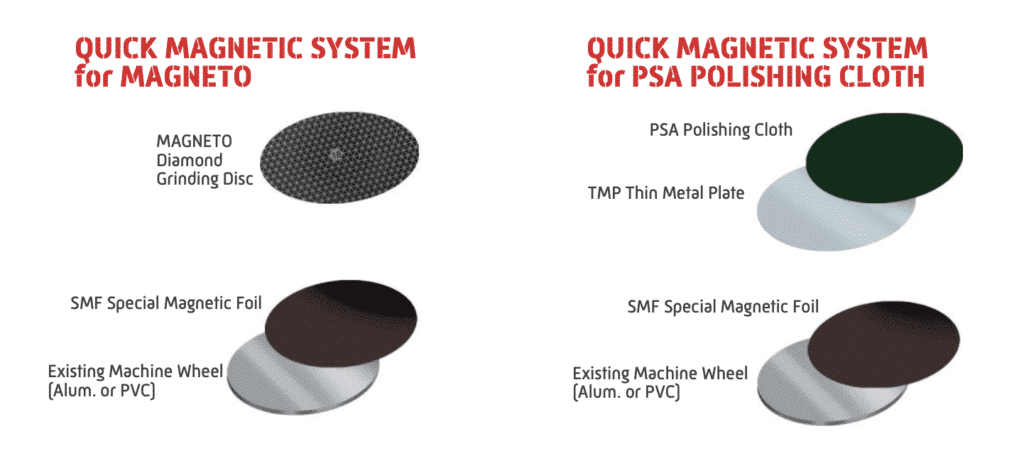
They can be cut freely and maintain a good shape, and they also remove stock quickly. Vitrified bonding discs use a glass-based bonding material to make them rigid and resistant to heat. They maintain their shape and size for extended periods. Most grinding discs come with PSA (Pressure Sensitive Adhesive) or magnetic backing. Magnetic backing also simplifies changes and allows you to move the discs smoothly during processing
Performance Factors That Influence Disk Selection
Various factors determine your selection of grinding disks for metallography from the performance point of view. Knowing these factors will guide you towards a better preparation and thus better performance throughout your preparation. Material removal rates come down to the size of the abrasive grit being used, speed of the equipment, and pressure applied. You will get faster removal with larger grits and higher speeds. But this might produce new deformations, meaning finding the right balance is key to successful work.
Accurate microscopic inspection of surfaces requires correct surface integrity. The ideal combination of abrasive and equipment conditions will result in a flat, damage-free surface that reveals the material’s inherent microstructure. Temperature management is a key factor as excessive heating can alter properties of the specimen and result in incorrect analysis.
Now you find the perfect lubricant to use here – this one has to deliver both cooling and lubrication and it depends on the material you’re working with. Soft materials require more lubricant to prevent damage, but they also don’t need a lot of abrasive because their wear is low. Hard materials have an entirely different system – they require relatively low lubricant but a considerably higher abrasive because the abrasive wears out more quickly. How deeply the deformation unfolds depends on the pressure you apply.
Rockwell Hardness Testing: Essential Guide for Quality Engineers
Too much force results in deeper damage under the surface; too little pressure simply wastes time. Use as little pressure as you can as you progress to finer abrasives. When you dress (reshape the grinding surface) on regular occasions, the life of the disk improves greatly. Such a process exposes new abrasive particles and removes clogged material, helping to achieve consistent results between your samples.
Matching Disk Type to Material Hardness
Accurate, reproducible and damage-free metallographic results depend heavily on suitable Disk type to hardness of material. Selecting a grinding disc will directly influence removal rates, the integrity of surfaces, and the efficiency of the subsequent polishing stages. Metkon Grinding Discs are engineered to yield superior results at a broad spectrum of material hardness — from soft, ductile metals to ultra-hard ceramics.
For hard and wear resistant materials such as tool steels, carburized components, and ceramics, the rigid discs with diamond or alumina abrasives offer good edge retention and minimal surface relief as well as controlled heat generation. For medium-hard materials such as structural steels, nickel-based alloys, and titanium, SiC or corundum discs can present a good compromise between cutting efficiency and surface finish, maintaining planarity without inducing too much deformation. For soft, non-ferrous or ductile alloys such as aluminum, copper, or lead-based alloys,

Metkon’s softer bonded discs possess a finer abrasive structure which minimizes smearing, cold work, and subsurface distortion. If all the disc composition, abrasive type, and grit size were systematically matched to the specific hardness of the specimen, it would significantly improve the preparation speed of the samples, maximize the life of the consumable, and achieve uniform results in all processing stages, including grinding. This process not only increases the accuracy of microstructural evaluation but also guarantees that the final polished surface accurately reflects the inherent properties of the material — a cornerstone of reliable metallography.
Conclusion
In this article we’ll discuss all about selecting grinding disks for metallography. So that the perfect choice of disk plays a crucial role in determining the quality and precision of sample handling. Familiarization with the different disk properties will achieve uniform results. Metal bond disks are best suited for highly abrasion-resistant materials. Resin bond types are versatile and effective in multiple applications. Electroplated disks provide free cutting action and vitrified bond disks maintain their shape under extended usage. Which backing (PSA or magnetic) makes your work a lot easier, and also speeds up your disks. Performance factors are a determining factor in which disk to choose. You will be forced to trade off material removal rates relative to what remains to preserve surface integrity. Control of heat generation ensures microstructural changes do not occur.
Good pressure balance and regular maintenance and keeping of the disk by dressing means that the disks last longer with a stable quality. Here is an unexpected principle: Harder materials require softer grinding wheels. For the sake of self-sharpening and increased grinding efficiencies. In order for each material which differs by hardness the specific recommended disk selection should be chosen with proper equipment.
Whether it is ceramics and superalloys or medium or soft steels, there is no denying that some technology is available. One excellent method now to get up to speed on selecting grinding disks for preparing metallographic samples is that of these techniques. The best choice integrates cutting force, shape-holding, and materials compatibility without the need for extreme material deformation of the sample. So your metallographic analyzes will give more accurate and reliable results, better material characterization, and problem-solving in industrial applications of all types.


