
Metallographic Cutting Guide: Pick the Right Machines, Wheels & Coolants
Metallographic Cutting Guide: Pick the Right Machines, Wheels & Coolants
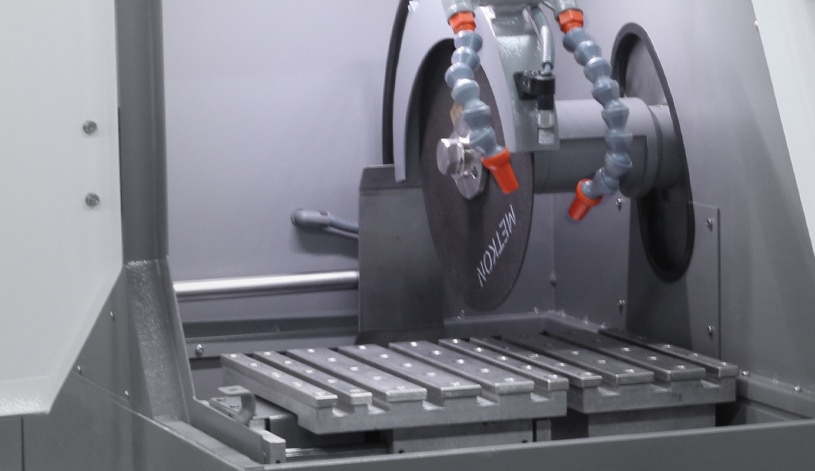
The right metallographic cutting machine can mean the difference between perfect samples and unusable specimens. Lab professionals often struggle with burn marks, micro-cracks, and deformation. These problems compromise analytical results and waste both time and materials.
Your metallographic sample preparation success depends on effective cutting techniques. The final results depend heavily on your choice of cut-off wheels, coolants, and cutting parameters. This holds true whether you work with titanium alloys, ceramics, or high-hardness steels. Small changes to feed rate or coolant flow can improve surface quality and prevent thermal damage substantially.
What is Metallography? Definition, Techniques & Industrial Applications
This piece gives an explanation about choosing between manual and automatic metallographic cutting machines. You’ll learn about selecting ideal abrasive or diamond cut-off wheels for specific materials and optimizing coolant selection. It also covers ways to troubleshoot common cutting problems, extend consumable life, and prepare sectioned specimens perfectly for subsequent metallographic analysis.
Understanding Metallographic Cutting Techniques
Quality metallographic analysis starts with the right specimen preparation and cutting techniques. Labs use two main cutting categories that serve different materials and research needs. Your choice of method will affect specimen quality and analysis results.
Abrasive Cutting vs. Precision Sectioning
Abrasive cutting stands as the go-to method in most metallography labs, working best with ductile materials. We used silicon carbide or alumina abrasives bonded within resin or rubber-resin matrices. These materials cut through metals, plastics, and composites quickly. The abrasive particles work like tiny cutting edges that remove material by controlled fracturing and chip formation.
Heat is the most significant issue in abrasive cutting. Excessive heat can alter your specimen’s microstructure and cause:
- Thermal damage at cut edges
- Microstructural changes that affect analysis
- Greater blade wear and shorter consumable life
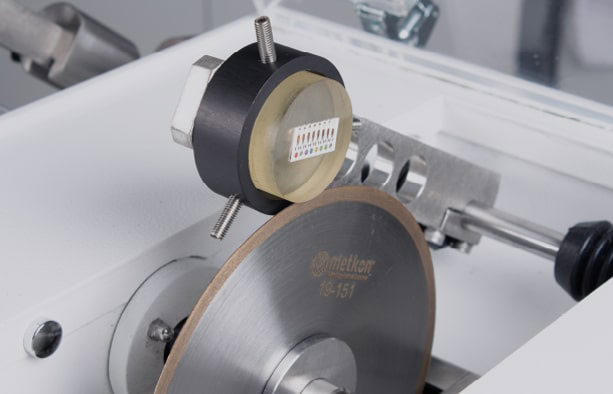
Precision sectioning provides greater control when working with hard or fragile materials. This technique employs diamond or cubic boron nitride (CBN) blades, which are thin. These blades make clean cuts with less deformation and hold close dimensional tolerances. The diamond particles are securely embedded in metal or resin bonds and result in extremely clean cuts with very little subsurface damage.
Following are the key differences among these techniques:
| Feature | Abrasive Cutting | Precision Sectioning |
| Blade thickness | 0.5-3.0 mm | 0.15-0.5 mm |
| Material removal | Higher | Minimal |
| Heat generation | Moderate to high | Low |
| Surface finish | Requires more post-cutting preparation | Near-final quality |
| Typical materials | Ductile metals, polymers, composites | Ceramics, minerals, electronic components |
When to Use Wafer Cutting for Ceramics and Minerals
Ceramics and minerals are difficult to prepare since they are hard and brittle. Precision wafer cutting reduces micro-cracking and maintains the structure.
The following parameters are most important when machining ceramics and minerals:
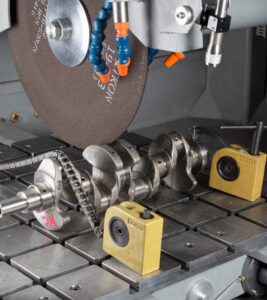
Speed selection: Diamond wafering blades work between 50-5000 rpm. Harder materials like ceramics and advanced minerals need higher speeds. This helps maintain cutting efficiency without adding pressure that might crack the specimen.
Load management: Loads range from 10-1000 grams. Ceramics often need higher loads (500-800 grams) to cut consistently. Very brittle specimens might need lower loads to avoid breakage.
Diamond concentration and size: More abrasives and larger sizes usually cut ceramics and minerals better. Larger diamond particles (100-120 μm) work great on extremely hard materials but might leave deeper damage below the surface.
Blade selection considerations: Diamond blades handle most ceramic cutting needs. CBN blades work better for specific tasks. CBN reaches 6000 HV hardness and excels at cutting hardened ferrous materials and alloys where diamond might break down due to carbon affinity.
Good practice prevents micro-cracking when wafer cutting. Cut into the coated face of coated materials so that the base material will support the cut. Brittle specimens need to be mounted in epoxy resin with vacuum impregnation to support all pores and potential crack sites.
Metallographic Etching: Key Techniques, Safety Tips &Choosing the Right Etchant
Feed speed control matters a lot for brittle materials. Hand cutting makes consistent feed rates impossible and often causes cracks. Automatic cut-off machines with adjustable feed speeds give much better results for ceramics, minerals, and other brittle specimens.
The correct cutting method and parameter optimization produce specimens that reveal the actual material structure—this forms the basis for effective metallographic analysis.
Common Issues in Metallographic Sample Cutting
Metallographic sample preparation often faces challenges that can affect specimen quality and analysis accuracy. Good equipment and techniques alone don’t guarantee success. Problems can still come up during cutting that need quick fixes. Knowing these common problems helps save time, materials, and gives reliable metallographic results.
How to Prevent Micro-Cracks in Brittle Materials
Micro-cracks are among the most frustrating problems when working with brittle materials. These often force you to completely recut samples. Poor cutting techniques or lack of material support usually cause these cracks.
Here is how to prevent cracks in brittle materials like ceramics or minerals:
- Adjust your cutting direction with coated materials. Cut into the coated side of the workpiece. This lets the base material support the structure during cutting.
- Mount properly prior to cutting. Mounting is required for small specimens to remain stable. Epoxy resin used in vacuum-impregnation is excellent. It enters all pores and possible crack locations, reinforcing the material from within.
- Control feed speed precisely with automatic equipment. Manual cutting makes it almost impossible to keep a steady feed rate with brittle materials. This leads to cracks. Automatic cut-off machines let you adjust feed speed precisely to cut challenging specimens without cracks.
Avoiding Delamination in Coated Samples
Coated materials are challenging to prepare, especially when layers delaminate or separate. Plated metals, painted surfaces, and multi-layer composites have a tendency to suffer from this.
Here is how to preserve coating while cutting:
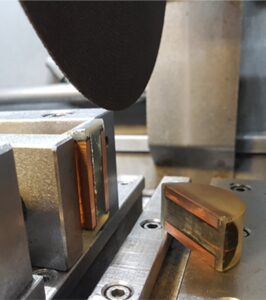
Proper orientation of the specimen is required initially. Sectioning on the coated side allows the substrate to support it and prevents peeling of the coating during sectioning.
Epoxy impregnation before sectioning is also helpful. It fills small gaps between the layers and bonds them together during cutting. The epoxy gets into all coating structure openings and creates a solid specimen that will not delaminate.
Small samples need to be mounted prior to cutting. This minimizes the risk of delamination significantly. The mounting medium encloses coating and substrate and holds them together during preparation.
What is the Vickers Hardness Test? | Method, Applications & Advantages
Troubleshooting Burn Marks and Overheating
Thermal damage manifests itself as a discoloration of cut surfaces. Worse still, it changes the microstructure of the material at different depths. You’ll need time-consuming grinding and polishing to eliminate this damage before analysis.
Burn marks typically occur due to:
Wrong cut-off wheel choice is a common cause of thermal damage. The right wheel makes preparation better and saves time and resources. Pick wheels based on material properties and cut size needs. Aluminum oxide wheels (about 2000 HV) work well generally. Silicon carbide wheels (about 2500 HV) are better for non-ferrous materials.
Too much feed speed generates heat more quickly than the coolant can dissipate it. Automatic cut-off machines provide greater control than manual cutting. Operators can reduce speed for heat-sensitive materials.
Poor coolant flow or wrong coolant type won’t remove heat well. Keep coolant levels up during cutting and change dirty coolant. Abrasive wheels break down while cutting and create debris that makes coolant less effective.
Bad blade preparation causes thermal damage. Allow the blade to come up to operating speed prior to cutting. Maintain constant force or employ light pulsing for optimum results.
Proper specimen clamping prevents movement while cutting. Poor clamping tends to damage blade and specimen, creating thermal issues as well. Clamp specimens from both sides whenever feasible for even support while cutting.
All of these problems are simpler to deal with if you know about them beforehand. Metallographic technicians can enhance sample quality and minimize preparation time and materials.
Selecting the Right Metallographic Cutting Machine
Sample quality, preparation time, and analytical accuracy depend heavily on your choice of metallographic cutting machines. The quality of your sample preparation starts with cutting, and your equipment choice affects every step that follows. Let’s get into what you need to know when choosing cutting machines for your metallographic laboratory.
Manual vs. Automatic Metallographic Cutting Machine
Feed rate control precision marks the main difference between manual and automatic cutting machines. Manual cutting machines need skilled operators who can maintain steady pressure while cutting. This approach works well enough for standard ductile material samples but creates variations that cause problems with challenging specimens.
Manual cutting machines possess the following features:
- Reduced initial costs
- Easy operation for simple applications
- Space-saving design for small laboratories
- Results that differ depending on operator expertise
Automatic metallographic cutting machines utilize programmable parameters to give reproducible results independent of the skill of the operator. The machines are ideally applicable to brittle materials, composite laminates, and samples that need accurate cutting.
| Feature | Manual Cutting Machines | Automatic Cutting Machines |
| Feed rate consistency | Variable (operator-dependent) | Precise (programmable) |
| Suitability for brittle materials | Poor | Excellent |
| Reproducibility between operators | Limited | High |
| Initial investment | Lower | Higher |
| Sample quality with difficult materials | Inconsistent | Consistent |
Automatic machines also have safety features that ensure operators and specimens are protected. You’ll have emergency stops, interlocked safety hoods, and automatic coolant systems that provide ideal cutting conditions.
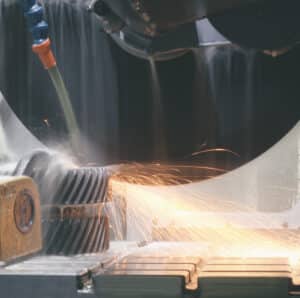
Feed Rate Control in Automatic Machines
Feed rate – the rate at which the cutting wheel moves through the specimen – is the most critical parameter in determining cutting quality. Automatic machines with adjustable or variable feed speeds possess outstanding advantages compared to manual machines.
Good feed rate control gives you several benefits:
- Prevents micro-cracks in brittle materials – Steady, controlled feed pressure prevents sudden force changes that cause cracks.
- Minimizes thermal damage – Correct feed rates balance cutting efficiency and heat generation to protect microstructure.
- Extends consumable life – Material-specific feed rates help cut-off wheels last longer.
Microprocessor–controlled feed systems on advanced automatic cutting machines maintain programmed rates constant during the cut and compensate as resistance varies. This is particularly valuable when cutting specimens of differing hardness or with intricate shapes.
Metallographic Etching: Key Techniques, Safety Tips & Choosing the Right Etchant
Noise and Vibration Reduction Features
Low cut quality and operator discomfort are common results of both excessive noise and vibration. Vibration can create micro-cracks in brittle materials, affect dimensional accuracy, and lead to more rapid equipment deterioration.
Metallographic cutting machines today employ a number of design features to minimize these issues:
- Heavy element vibration-damping bases absorb cutting vibrations
- Precision-balanced cut-off wheels reduce operating vibration
- Acoustic enclosures create a quieter laboratory environment
- Rubber isolation mounts stop vibration from being transmitted to surrounding surfaces
Good quality metallographic cutting machines are constructed with a stiff construction throughout the cutting assembly. This solid construction maintains motors, arbors, and clamping systems in precise alignment, addressing vibration at its root instead of merely dampening it afterward.
Your standard specimen material and need for reproducible results will dictate the machine selection. Labs working with brittle materials, coated specimens, or needing consistent results from multiple operators will find automatic machines with advanced feed control and vibration damping to be worth the higher initial cost.
Choosing the Best Cut-Off Wheel for Your Material
The cut-off wheel represents the critical interface between machine and specimen. The selection of the correct wheel is just as important as the selection of cutting equipment. Your choice of wheel influences cutting speed, specimen quality, and preparation time. There are numerous choices available on the market, and an understanding of the essential differences allows you to select the appropriate wheel for your material.
Diamond Cut-Off Wheel vs. Abrasive Wheel Comparison
Abrasive and diamond cutting discs work on different principles. Both types of wheels have specific advantages for different materials. The distinction is a significant consideration in the design of your metallographic preparation flow.
Diamond cutting discs contain diamond particles bonded in metal or resin bonds. These wheels perform optimally with materials having 500-2400 HV. Diamond is extremely hard (approximately 8000 HV), and thus these wheels are ideal for:
- Hard metals and alloys
- Minerals and ceramics
- Electronic components
- Composite materials
Abrasive cutting discs contain aluminum oxide or silicon carbide grains held together by resin or rubber bonds. These wheels cut softer materials, usually less than 700 HV, beautifully. They possess the following benefits:
- Cost less than diamond wheels
- Cut soft to medium-hard metals faster
- Offer more flexibility in cutting operations
- Handle larger cross-sections better
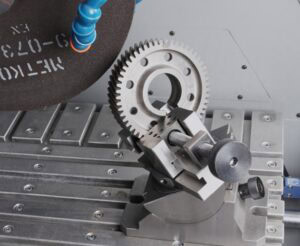
Medium-grade abrasive wheels are best for materials ranging from 100-500 HV (medium-soft ferrous metals). Softer abrasive wheels are suitable for materials in the range of 500-700 HV (hard ferrous metals) and minimize heat generation and surface deformation.
Resin-Bonded Wheel for Ductile Metals
Cutting ductile metals presents some special challenges. These metals will deform rather than break cleanly and can therefore cause:
- Wheel loading (material accumulation on the cutting surface)
- Too much heat
- Material dragging or smearing
Resin-bonded wheels surmount these challenges through their special composition. As you cut, the resin bond matrix is worn away, exposing new abrasive particles. This self-sharpening action sustains the wheel’s cutting capability for its entire life.
The best results with ductile metals is achieved by:
- Selecting wheels having the correct bond hardness for your material
- With sufficient coolant to avoid material sticking
- With medium cutting pressure so that the wheel self-sharpens
Most ferrous metals cut nicely with resin-bonded wheels utilizing aluminum oxide abrasives. Non-ferrous metals such as aluminum and copper alloys usually to cut better with silicon carbide abrasives.
Abrasive Size vs. Wheel Hardness Matching
The abrasive particle size and wheel hardness combination is crucial but often overlooked. Compromise these properties based on your material.
Abrasive size determines cutting speed and surface finish:
- Larger particles (coarser wheels) cut more quickly but produce rougher surfaces
- Smaller particles (finer wheels) cut more slowly but produce smoother finishes
Wheel hardness refers to how tightly the bond holds the abrasive particles:
- Stronger bonds hold particles longer, which prolongs wheel life but generates more heat
- Softer bonds release particles earlier, creating a self-sharpening action but shorter wheel life
The best cutting performance is provided by:
| Material Type | Recommended Abrasive Size | Ideal Wheel Hardness |
| Soft ductile metals | Medium to coarse | Medium to hard |
| Medium-hard alloys | Medium | Medium |
| Hard/brittle materials | Fine to medium | Soft to Medium |
Diamond wafering blades cut differently when slicing through extremely hard materials such as minerals and ceramics. Increasing abrasive size and concentration tends to enhance cutting efficiency in these instances. CBN wheels, which have a hardness of approximately 6000 HV, are excellent for hardened ferrous alloys and materials where the diamond can deteriorate because of carbon affinity.
How to Prepare Metallographic Samples – Complete Step-by-Step Guide (With Expert Tips)
Properly matching abrasive size and wheel hardness enables efficient removal of material with a minimum of heat damage. This creates specimens that truly represent the original material structure.
Coolant Selection and Flow Optimization
Proper coolant handling can make or ruin your metallographic cutting operation. Your samples can suffer from thermal damage despite an excellent cutting machine and ideally matched cut-off wheels if you fail to select and provide the correct coolant. An excellent coolant performs three critical functions: it controls temperature, removes waste, and lubricates – these have a direct impact on your specimen quality and how long your equipment will hold up.
Water-Based Coolant vs. Oil-Based Coolant
Your material properties and cutting requirements will determine the choice between water-based or oil-based coolants. There are applications where each excels.
Water-based coolants are excellent at dissipating heat and thus ideal for the majority of metallographic cutting applications. The solutions have additives that enhance their performance:
| Component | Function |
| Corrosion inhibitors | Prevent oxidation of freshly cut surfaces |
| Wetting agents | Improve surface contact and cooling efficiency |
| Biocides | Prevent bacterial growth in recirculation systems |
| Lubricants | Reduce friction between cut-off wheel and specimen |
Water-based solutions give you better heat transfer, easier cleaning, and less environmental issues. They work effectively with most ferrous and non-ferrous metals in automatic metallographic cutting machines.
Oil-based coolants excel when you require additional lubrication for certain materials. They are most effective when cutting:
- Reactive metals such as magnesium and titanium
- Substances that readily rust with water
- Specimens that shouldn’t oxidize much
Coolants that are oil-based may be more expensive and you’ll require special disposal practices, but they can extend the life of your cut-off wheels significantly when cutting abrasive or difficult materials.
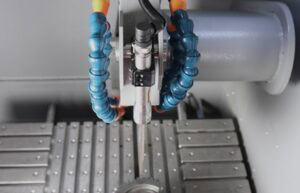
Coolant Flow Rate Recommendations
Insufficient coolant flow is one of the primary causes of thermal damage occurring during metallographic cutting. The coolant must flow to the cutting interface with a sufficient volume to manage the heat.
Here’s what you should strive for with automatic metallographic cutting machines:
- Soft to medium-hard materials (75-500 HV): Maintain flow rates of 2-4 liters per minute. This provides adequate coverage without exerting too much pressure on thin specimens.
- Hard materials (500+ HV): Increase push flow rates to 4-6 liters per minute to manage the additional cutting heat in harder materials.
Your feed rate influences the amount of coolant you will require – harder cuts generate more heat and require additional coolant. The ideal flow should allow coolant and chips to exit the cutting area cleanly without splashing all over.
How you apply coolant is as important as how much you apply. Direct the coolant stream squarely at the area where the specimen and the cut-off wheel intersect, from both sides if you can. This cools things down where the majority of heat is generated.
Effect of Coolant Temperature on Cutting Performance
Coolant temperature is an enormous contributor to cutting efficiency, but this is an area that most labs overlook. Warm coolant does not possess the heat-absorbing quality of cool coolant.
You need to monitor coolant temperature for recirculating systems. It begins to go wrong when temperatures exceed 30°C (86°F). At 40°C (104°F) or more, your coolant loses its effectiveness, which can result in:
- Greater thermal damage to specimens
- Faster cut-off wheel wear
- Less efficient cutting
- Potential changes in microstructure of heat-sensitive materials
Your coolant will perform optimally between 18-25°C (64-77°F). If you are doing a great deal of cutting, consider investing in coolant chillers to maintain consistent temperatures regardless of the ambient temperature or how long you have been cutting.
Keep your coolant clean is essential. Dirty coolant will not cool as efficiently and could harm your equipment, so change it when necessary. Monitor your coolant levels prior to starting to cut so that you have sufficient for the entire job.
Material-Specific Cutting Guidelines
Different materials have their own unique difficulties in metallographic cutting. You merely need material-specific parameter modification for the best outcomes. Getting these material-specific techniques right will give you a specimen that accurately reflects the original microstructure without preparation artifacts.
Optimizing Cutting Parameters for Titanium Alloys
Titanium alloys only require special attention during metallographic cutting due to their low thermal conductivity and chemical reactivity. Heat accumulates more quickly at the cutting interface as you cut titanium samples. This may result in thermal damage and alteration of the microstructure.
In order to achieve the optimum results when sectioning titanium alloys:
- Feed speed: Maintain slower feed rates (approximately 30-40% less than normal metals) to minimize heat
- Wheel selection: Use high-concentration diamond wheels or titanium special cutting discs with better heat dissipation
- Cutting direction: Cut transverse to the rolling direction in titanium plates or sheets whenever possible
Burrs are common when cutting titanium and create false microstructural characteristics. You can prevent this by clamping the specimen with clamps on each side of the cut instead of single-point clamping. This type of dual-support method puts even pressure on the cut.
Best Coolant for Stainless Steel Sectioning
Poor thermal conductivity of stainless steel makes heat dissipation during sectioning difficult. The selection of the correct coolant is critical to avoid thermal damage as well as corrosion problems.
First, lots of coolant is directed right at the cutting interface. Water-based coolants that contain corrosion inhibitors are best for stainless steel samples. Special formulations are an excellent means of achieving:
- Better heat removal than standard water
- Prevention of flash corrosion on newly cut surfaces
- Improved lubrication that extends the life of cut-off wheels
Stainless steel simply requires more coolant than ordinary steels—typically 4-6 liters per minute in automatic cutting machines. Monitor coolant temperature because it is less effective when above 30°C.
Low-Deformation Sectioning of High-Hardness Steels
High-hardness steels (above 65 HRC) are hard to section without deforming. These materials have a tendency to micro-crack, surface harden, or develop soft spots when not sectioned correctly.
To minimize deformation:
- Cut-off wheel choice: Cubic Boron Nitride (CBN) wheels are more effective than conventional abrasives for hardened ferrous metals. CBN wheels remain effective without producing excessive heat due to their hardness of almost 6000 HV.
- Automatic cutting machines with controlled feed give better results than manual ones. Knowing how to use consistent, controlled pressure along the cut reduces deformation risks.
- Support considerations: Mounting of small high-hardness specimens before sectioning gives essential stability. Epoxy resin may also be utilized in vacuum-impregnation for impregnating potential crack sites.
Feed control is the most critical. High-hardness steels require slower, more controlled cutting. Automatic metallographic cutting machines incorporate special cutting techniques and variable feed rates that are best suited to do this. Inconsistent or too-fast cutting will generate micro-cracks in these brittle materials.
There are challenges with every type of material. With the appropriate parameter settings, coolant choice, and cutting technique modifications, you can produce metallographic specimens that accurately reflect the original material structure.
Post-Cutting Sample Handling and Preparation
A good sectioning operation involves handling of the specimen that’s just as critical as the cutting itself. Your ultimate metallographic examination is only as good as what you do in these subsequent steps following cutting.
Cleaning Specimens After Sectioning
Your sample requires cleaning as soon as possible after sectioning to remove cutting residue and shield newly exposed surfaces from contamination. Begin by rinsing the sample under running water to dislodge loose particles. Samples with complex features or porous surfaces perform best in an ultrasonic bath with an appropriate cleaning solution.
Beware of these everyday cleaning issues:
- Soft materials can trap residual abrasive particles
- Coolant film residue can impact mounting adhesion
- Reactive metals may form flash corrosion with aqueous cleaners
Your samples need to be completely dry before you can move on to the next steps. Use compressed air or lint-free wipers to achieve this.
Sample Mounting Considerations After Cutting
Mounting does more than just simplify handling of the samples—it provides essential structural support during preparation. Small specimens must be mounted, particularly brittle materials or multilayer samples.
Epoxy resin via vacuum-impregnation is superior to other mounting methods. It enters all the pores, cracks, and voids of the specimen to provide complete structural strengthening. It also excludes air bubbles that ruin mounting quality.
Coated or layered samples must be orientated facing upwards in the mount. This continues the same support principle as during cutting—the foundation material continues to lend structural strength throughout grinding and polishing.
Surface Finish Before Grinding and Polishing
The finish of your sectioned surface plays a significant role in prep efficiency. Bad cuts mean lots of grinding to get to a level starting point, while good cuts might need minimal effort.
State-of-the-art cutting parameters still call for you to search for these typical surface problems:
- Micro-cracks spreading from cut edges
- Burnishing or smearing on ductile materials
- Uneven surfaces that need leveling before fine grinding
Most metallographic samples need to be ground and polished step by step in order to show their true microstructure, even with perfect cutting. However, a clean starting specimen that is well-supported and has fewer cutting artifacts will save time in preparation and provide consistent, repeatable results.
Extending Equipment and Consumable Life
You can minimize operating expenses and ensure repeatability of cutting quality by extending the life of your metallographic equipment. Laboratories can economize without sacrificing sample quality by maintaining equipment properly.
Cut-Off Wheel Dressing Techniques
Cut-off wheels become less efficient as their cutting face becomes glazed or loaded with material. Proper dressing can restore these faces and increase wheel life by 20-30%.
Here is how to achieve optimum wheel performance:
- Let blades reach full operating speed before making contact
- Apply constant pressure or gentle pulsing motion rather than cutting forcefully
- Apply light dressing to reveal new abrasive as cutting becomes ineffective
Diamond wheels require periodic light dressing using aluminum oxide dressing sticks.
Consumables Cost per Cut Optimization
The right combination of consumable choice and operational condition minimizes cost per cut. Abrasive wheels wear out while cutting and create debris. Several factors affect how well they perform:
Your wheel must precisely fit your material. Aluminum oxide wheels (~2000 HV) are suitable for general use. Silicon carbide wheels (~2500 HV) work best on non-ferrous materials. Diamond wheels (~8000 HV) function better with ceramics and minerals. CBN wheels (~6000 HV) often cut hardened ferrous materials more effectively.
Feed speed is a major determining factor in the longevity of consumables. Automatic cut-off machines with variable feed speed are more cost-saving than manual machines because they ensure constant cutting pressure.
Eco-Friendly Cutting Fluids for Lab Use
Laboratories today focus on green chemistry without a loss in performance. Cutting fluids today contain biodegradable additives and lower volatile organic compounds.
Special additives in recirculation systems improve cooling efficiency and fluid life. Check the coolant level regularly and replace dirty fluids. Recirculation systems must be cleaned regularly to prevent accumulations that degrade cooling performance.
Seek the following characteristics when selecting environmental-friendly coolants for metallographic practice:
- Better lubrication to reduce wheel wear
- Good heat transfer characteristics
- Biodegradable materials with low environmental effect
- Decreased bacterial growth in recirculation systems
These procedures enable metallography laboratories to prolong equipment life, reduce costs, and conserve the environment without sacrificing specimen quality.
This step-by-step guide discusses how metallographic cutting impacts sample quality and analytical integrity. Proper sample preparation begins with correct cutting methods, equipment selection, and optimized conditions.
Your result depends heavily on the choice between abrasive cutting and precision sectioning. Abrasive methods are optimally suited for ductile materials. Precision sectioning allows better control for brittle specimens. You should know your material properties before any cutting operation.
The right instrumentation by itself can make an enormous difference in sample preparation. Automatic cutting machines offer programmable parameters and repeatable feed rates. Manual options can’t compete with these features, especially if you’re dealing with difficult materials like ceramics or layered composites.
With the correct cut-off wheels according to material characteristics, your preparation is improved and your wheels have a longer life. Diamond wheels perform well with harder materials over 700 HV. Resin-bonded abrasive wheels are more suitable for softer, ductile metals.
Coolant control is important but gets overlooked normally. Coolant type, flow, and temperature stop heat damage that ruins your analysis. Water-based coolants work for most applications. Oil-based types are better with reactive metals.
Special handling is given to every material. Titanium needs slower feeds because it is not a good conductor of heat. Stainless steel needs plenty of coolant with corrosion inhibitors. Very hard steels need controlled, precise cutting to avoid micro-cracks and distortion.
Good cleaning, mounting, and surface preparation following cutting form the foundation for further metallographic operations. They enable your specimens to display the actual material properties without artifacts. Proper techniques and regular maintenance make your equipment longer lasting and less expensive to operate. Dressing diamond cut-off wheels, streamlining parameters, and selecting the correct coolant result in improved laboratory operations. Metallographic cutting may seem straightforward, but as we have indicated, these technical details are what make all the difference. Either your samples will be damaged, or they will reveal the actual material properties. Mastering these methods saves time, wastes less material, and provides consistent results every time.
FAQ Metallographic Cutting
Q1. Why are coolants used in metallographic cutting? Coolants have three important functions in metallographic cutting: temperature control, debris flushing, and lubrication. They avert thermal damage to specimens, prolong equipment life, and guarantee faithful representation of the microstructure of the material.
Q2. How do manual and automatic metallographic cutting machines differ? Manual machines rely on operator skill for feed rate control, while automatic machines incorporate programmable parameters for repeat cutting. Automatic machines are more precise, especially for brittle materials and layered composites, but have a higher initial cost.
Q3. What are the considerations in choosing a cut-off wheel? The main considerations are the hardness of the material, type of wheel bond (metal or resin), abrasive material (silicon carbide, aluminum oxide, or diamond), and abrasive particle size. When these are matched to your particular material, you have efficient cutting and reduced thermal damage.
Q4. How is thermal damage prevented in metallographic cutting? Prevent thermal damage by choosing the right cut-off wheels, feed speed control, proper coolant flow, and proper blade preparation. The use of automatic machines with controlled feed rates also assists in controlling heat generation.
Q5. What are the optimum practices in post-cutting sample handling? Clean the specimens after cutting to get rid of debris, mount for structural support if necessary (especially for small or brittle samples), and examine the surface finish before grinding and polishing. Proper post-cutting handling preserves the material microstructure representation accuracy in further analysis.


