XRF vs OES Metal Analysis: Which Method Delivers Better Results? [2026]
XRF vs OES Metal Analysis: Which Method Delivers Better Results? [2026]
XRF metal analysis and OES testing stand out as the most reliable methods to ensure metal quality. This quality directly impacts safety, performance, and durability. The right choice between these technologies depends on understanding their basic differences. Both techniques deliver excellent accuracy and precision with random measurement errors as low as 0.5%, but they work on completely different principles.
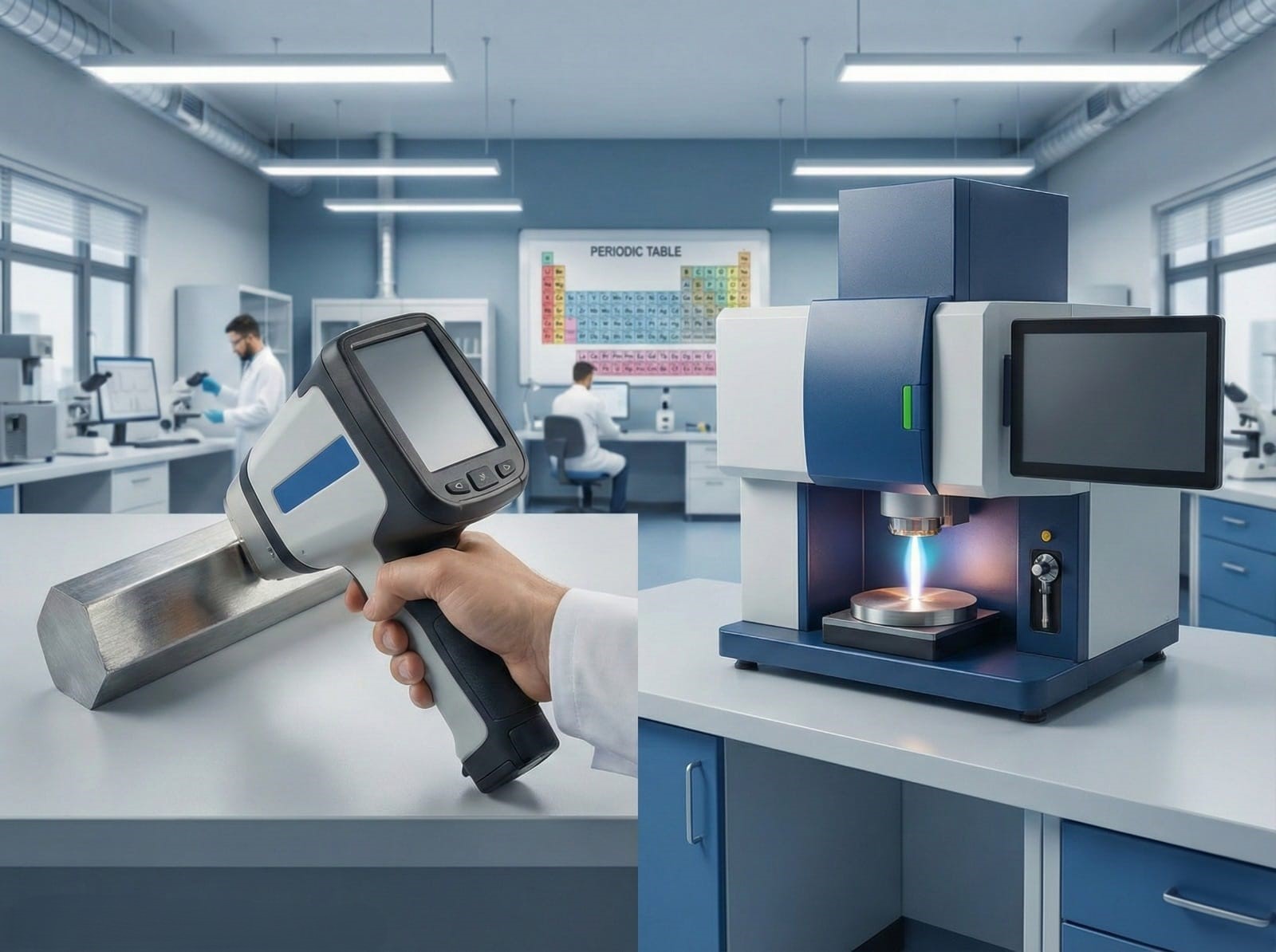
The debate between XRF vs icp-like technologies shows unique benefits from each method. XRF technology directs an X-ray beam at the material’s surface and works great with solids, powders, and liquids. OES creates a high-energy electrical spark between the instrument and the sample. Portable XRF units are perfect to analyze precious metals. But OES remains the only way to get accurate readings for light elements like carbon, phosphorus, and sulfur. XRF metal analysis struggles to detect very light elements below magnesium, though it gives better precision for other elements. Your specific testing needs will determine which of these technologies lines up best with your requirements.
How XRF and OES Technologies Work
Metal analysis technologies work in different ways, and knowing how they work helps us understand their best uses. These methods rely on different physical principles that shape their applications.
XRF Principle: Fluorescence from X-ray Excitation
XRF metal analysis starts when a primary X-ray beam hits the sample surface. The high-energy radiation makes atoms excited by pushing electrons out of their innermost orbitals. Electrons from outer shells then move down to fill empty spaces and release extra energy as secondary X-rays—this process is called fluorescence. Each element creates its own unique “fingerprint” of X-ray energies that helps identify it precisely. A detector captures this radiation and measures both the energy to identify elements and intensity to measure their amounts.
OES Principle: Spark-Induced Light Emission
OES works differently from XRF. It creates a high-energy electrical spark between the instrument electrode and the metal sample. The controlled spark turns a tiny bit of material into plasma that heats up to thousands of degrees Celsius. The atoms in this plasma get excited and emit light at specific wavelengths that match each element. This light spans the visible and ultraviolet spectrum (130-800 nanometers). The light goes through an optical system where diffraction gratings separate it by wavelength. Detectors then measure this light to determine what elements are present.
Sample Interaction: Non-destructive vs Micro-destructive
The main difference between these technologies lies in how they interact with samples. XRF’s biggest advantage is that it doesn’t damage the sample—this makes it perfect to test finished products, valuable items, or specimens that must stay intact. Sample preparation is simple and usually needs just surface cleaning. OES leaves a small, permanent burn mark on the sample where the spark hits. It also needs mechanical sanding to prepare the sample surface to get accurate results.
Element Detection Capabilities
Element detection capabilities are the main difference between these analytical technologies. These capabilities determine which method works best for specific testing needs.
Light Elements: Carbon, Sulfur, Phosphorus Detection in OES
OES technology excels at detecting light elements that play a vital part in metal grading. OES remains the only method that can analyze carbon and nitrogen outside laboratory settings. This makes it significant when you need to verify carbon content against strict specifications. OES delivers precise results with detection limits as low as 0.13 mg/L for phosphorus and 0.01 mg/L for carbon. To name just one example, Type 316 stainless steels show how a tiny 0.04% difference in carbon content separates standard 316 from its more corrosion-resistant 316L variant.
Heavy Metals: XRF for Mid-to-High Atomic Number Elements
XRF metal analysis works best with elements of higher atomic numbers. This technique analyzes elements from sodium (11) to curium (96), depending on the instrument’s configuration. Advanced wavelength-dispersive XRF systems can detect elements starting from beryllium (4). The basic physical principles make XRF effective especially when you have heavy metals to detect. Elements like lead and mercury create higher fluorescence yields compared to lighter elements. These properties make XRF heavy metal analysis perfect for environmental screening and industrial applications that need mid-to-high atomic number element detection.
Trace Element Sensitivity: Detection Limits Compared
Both technologies are a great way to get specific advantages in sensitivity. OES detects trace elements down to parts-per-million levels with outstanding accuracy. OES remains the preferred method to analyze trace metals, especially when you have critical manufacturing applications. High-power XRF instruments achieve exceptional sensitivity at parts-per-million to sub-parts-per-million levels, though they’re nowhere near as effective for ultratrace detection below parts-per-billion. Modern XRF instruments provide enough sensitivity to verify compliance with action levels in regulatory testing.
Operational Factors and Portability
Metal analysis technologies work differently based on several factors that substantially impact their usefulness in testing environments of all types.
Sample Preparation: Minimal for XRF vs Polished Surface for OES
XRF metal analysis works with almost no sample preparation. You can test materials “as-is”. This saves time and prevents workflow delays. XRF stands in sharp contrast to OES, which needs proper surface preparation. OES samples must have a clean, flat surface prepared with zirconium aluminum oxide sanding disks. Poor sample preparation leads to inaccurate and unwanted OES results.
Portability: Handheld XRF vs Benchtop OES
XRF shines in mobility with handheld analyzers that weigh under 6.5 pounds, battery included. Users can analyze samples right on the spot, even in tough-to-reach areas. OES systems are more “transportable” than portable. They weigh between 45-60 pounds plus a 20-pound argon tank. Moving these heavy units often needs mechanical help, especially in elevated work areas.
Speed of Analysis: Instant Readings vs Lab-Grade Timing
XRF gives you results in 10-30 seconds, while OES produces readings in as little as 20 seconds. Both technologies provide quick feedback, but OES has a slight advantage for live decision-making.
Maintenance and Consumables: Argon Use in OES
OES systems depend on argon gas to detect light elements below 200nm wavelength. The system needs proper argon pressure above 300 psi and leak-free tubing to ensure accurate results. XRF systems are simpler – they don’t need consumables or complex maintenance.
Cost, Accuracy, and Use Case Fit
The choice of metal analysis technology comes down to finding the right balance between cost and your technical needs.
Original Investment: XRF vs OES Equipment Cost
XRF technology makes more financial sense as it costs less upfront. You’ll need a bigger budget for OES instruments. XRF systems save you money with lower maintenance costs and simpler operations. OES systems need constant supplies like argon gas and skilled operators, which adds up to higher ownership costs over time.
Accuracy and Precision: Lab-Grade vs Field-Grade
XRF accuracy changes based on what you test. It works great for gold in jewelry with 0.2-0.5% precision but might vary up to 20% with mineral samples. The technology works better with heavier elements than lighter ones. OES stands as the standard for lab analysis because it gives better precision, especially when you have light elements to measure.
Best Use Cases: Scrap Sorting, Alloy Verification, Quality Control
XRF shines at quick material identification, which makes it perfect for scrap sorting and recycling. To name just one example, see how XRF metal analysis can tell 304 from 316 stainless steel by detecting about 2% molybdenum. OES fits best in manufacturing where strict quality control matters, especially if you need to check carbon content.
Best Times to Use Both: Complementary Roles in Large Operations
Quality-focused industries often use both technologies together. They use handheld XRF to screen materials quickly without damage and lab OES to certify final results and verify exact compositions. This combined approach helps streamline processes while meeting strict quality standards.
Comparison Table
| Characteristic | XRF (X-Ray Fluorescence) | OES (Optical Emission Spectroscopy) |
|---|---|---|
| Operating Principle | Uses X-ray beam to excite atoms that cause fluorescence | Creates high-energy electrical spark to generate plasma and emit light |
| Sample Interaction | Non-destructive | Micro-destructive (leaves burn marks) |
| Light Element Detection | Poor detection below magnesium and cannot detect carbon | Excellent detection of light elements (carbon, phosphorus, sulfur) |
| Detection Range | Sodium (11) to curium (96) | 130-800 nanometers wavelength range |
| Sample Preparation | Minimal preparation with surface cleaning only | Needs mechanical sanding and polished surface |
| Portability | Highly portable (under 6.5 pounds) | Semi-portable (45-60 pounds plus 20-pound argon tank) |
| Analysis Speed | 10-30 seconds | Around 20 seconds |
| Maintenance Requirements | Low maintenance without consumables | Needs argon gas and regular maintenance |
| Original Cost | Lower investment | Higher investment |
| Accuracy | 0.2-0.5% for heavy elements, up to 20% variation for minerals | Superior precision for light elements |
| Best Applications | Scrap sorting, recycling, rapid material identification | Manufacturing QC, carbon content verification, laboratory analysis |
Optimizing OES Results with Precision Preparation
As highlighted in the comparison, OES technology requires meticulous sample preparation to deliver accurate results, particularly for light elements like carbon and sulfur. To meet this critical requirement, the SPECTRAL 350 Spectroscopic Dual Disc Surface Grinder serves as an essential solution for laboratories handling iron and steel samples. Unlike general-purpose grinders, this specialized machine is engineered to produce the exact surface quality needed for reliable emission spectroscopy. By ensuring a perfectly flat and clean surface, the SPECTRAL 350 eliminates the risks of poor sample contact and contamination that can lead to erroneous OES readings.

The SPECTRAL 350 excels in both efficiency and precision, featuring a robust dual-disc design that streamlines the workflow in high-volume testing environments. Its ability to achieve excellent precision flat surfaces ensures that the OES spark interacts perfectly with the material, maximizing the instrument’s detection capabilities. For manufacturing facilities and quality control labs where accuracy is non-negotiable, integrating a high-performance preparation system like the SPECTRAL 350 is the key to unlocking the full potential of spectroscopic analysis and ensuring consistent material quality.
Key Takeaways
The choice between XRF and OES metal analysis comes down to your specific testing needs rather than picking one as the best overall solution. Both technologies give excellent results but shine in different ways.
XRF’s biggest strengths are its non-destructive testing method, minimal prep work, and great portability. These features make it perfect for field work like scrap sorting, recycling operations, and quick material identification. It also works really well with heavier elements and comes at a more affordable price point for many companies.
OES becomes essential when you need to test light elements like carbon, phosphorus, and sulfur – elements that XRF just can’t detect. While it’s micro-destructive and costs more, OES remains the top choice for manufacturing quality control, especially when you need to verify carbon content for critical material properties.
These technologies differ beyond just how they work. XRF needs almost no maintenance or supplies, but OES needs argon gas and regular upkeep. The weight difference is significant too – XRF analyzers are light at under 6.5 pounds, while OES systems are much heavier at over 45 pounds plus extra equipment.
Many quality-focused companies get great results by using both technologies strategically. They use XRF to screen materials and run non-destructive tests, then confirm important measurements with OES when needed. This approach streamlines processes while maintaining high quality standards.
The question “which gives better results?” becomes more about picking the right tool for your specific needs. Companies should review their unique requirements – how portable they need it to be, what their budget looks like, which elements they need to detect, and whether they need to preserve samples. A full picture of these factors helps teams pick the technology that works best for their testing environment.