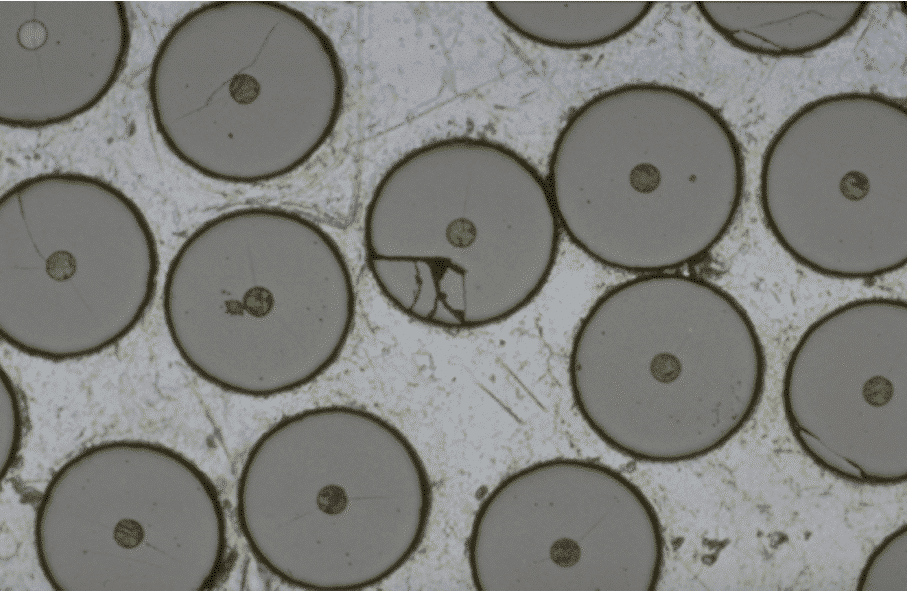
Optical, electron, and digital microscopy techniques for detailed sample analysis.
PRINCIPLE OF MICROSCOPY
Working Principle:
•Microscopy is to get magnified image, in which structures may be resolved which could not be resolved with the help of an unaided eye. •In the type of illumination there are adjustable collector lens in front of the source of light. •Image formation occurs in two stages the firt is formed by the objective. It is real, invert and magnified.
Resolving Power:
•The useful magnification of microscope is limited by it is resolving power. •The resolving power in limited by wavelength of illuminating beam •Resolution is determined by certain physical parameters like wave length of light and light generating power of the objective & condenser lens
Numerical Aperture (NA):
• The numerical aperture of a lens is the ratio of the diameter of the lens to it is focal length. •NA of a lens is an index of the resolving power •NA can be decreased by decreasing the amount of light that passes through a lens.
Limit of Resolution:
•It is the minimum distance between two points to identify them separately. Limit of resolution is inversely proportional to power or resolution. If the wavelength is shorter then the resolution will be greater. •Working distance: It is the distance between the objective and the objective slide. •The working distance decreases with increasing magnification •Magnification: It is the ratio of the size of an object seen under microscope to the actual size observed with unaided eye.
Image Brightness
•Where NA is the objective numerical aperture and M is the magnification. The ratio given in the equation above expresses the light-gathering power of the objective in trans illumination. •The intensity of illumination depends on the square of the condenser numerical aperture and the square of the demagnification of the light source image. •The result is that brightness of the specimen image is directly proportional to the square of the objective numerical aperture as it reaches the eyepiece or camera system. •Therefore, when examining specimens in transmitted light, changing the objective without altering the condenser affects image brightness in response tı changes in NA and magnification
•Different types of the microscopes and below you can find 4 of them: •Light Microscopes (Inverted, Upright) •Stereo Microscopes •Confocal Microscopes •Electron Microscopes
Light Microscope:
1.Light microscopes are simplest of all microscopes. 2.Use lenses to bend and focus light rays to produce enlarged images of the small objects. 3.Light microscopes are used to view samples that can not be seen with the naked eye. The magnification of a microscope is most commonly 40x, 100x, 400x and sometimes 1000x. 4. Inverted microscopes are used to examine large parts at high magnification for fractures or faults. One primary difference is that the samples are placed smooth side and samples must be prepared so it can lay flat on the stage.
Stereo Microscopes
1.Stereo microscopes are used to look at variety of samples that you would be able to hold in your hand. 2.A stereo microscope provides a 3D image and typically will provide magnification beetween 10x-40x 3.provides both transmitted and reflected illumination and can be used to view a sample that will not allow light pass through it. 4.Uses for this type of microscope include looking surfaces, watch making, and inspecting circuit boards etc.
Laser Scan Confocal Microscopes
1.Unlike stereo and light microscopes, which use regular light for image formation, the confocal uses a laser light to scan samples that have been dyed 2.. Beam has ab exceptionally short wavelength, is strikes most objects in it is path and increases the resolution of the microscope significantly. These samples are prepared on slides and inserted, with the aid of ta dichromatic mirror, the devices produces a magnified image on a computer screen. 3.Operators can create 3D images, as well, by assembling multiple scans. 4.Their resolution is better than light microscopes and they are commonly used in cell biology+ medical application.
CONTRAST METHODS
Bright Field (BF)
•The most elementary form of microscope illumination techniques and is generally used with light microscopes. •The name is derived from the fact that the sample is dark and contrasted by the surrounding bright viewing field. •The microscope should have alight source that can provide intense illumination necessary at high magnifications and lower light levels for lower magnifications. •Some specimens can be viewed without staining and the optics used in the bf technique do not alter the color of the sample.
Darkfield (DF)
•The light path for DF illumination passes through an outer hollow ring of the objective, falls onto the specimen at a high angle of incidence, reflects off the surface, then passes through the interior of the objective lens, and finally reaches the eyepiece or camera •For samples having a flat surface with occasional non-flat features (cracks, pores, etched grain boundaries, etc.) •The DF image shows a dark background with brighter areas corresponding to the non-flat features, which scatter more light into the objective.
Phase Contrast
•The basic principle to making phase changes visible in phase-contrast to separate the illuminating light frım the sample-scattered light and to manipulate these differently. • Some of the illuminating light is scattered by the sample with different colors (green, yellow and red) When observing an unstained sample the scattered light is weak and typically phase-shifted by -90 angle. • Background having nearly the same intensity,resulting in low image contrast. •Light can aso be described as electromagnetic vibration, which travels outwards from source of it is propagation, much in the same way as vibration along a rope.
Pure Aluminium Microstructure
a)Bright Area b)Polarized Light
Differantial Interference Contrast (DIC)
•In this complex form of polarised light microscopy two slightly separate, plane polarised eams of light are used to create a3D like image with shades of grey. •Care must be taken to interpreting DIC images as the apparent hills and valleys in the samples can ve misleading. •The height of a hill is a product of both the actual thickness of the feature and it is refractive index. •Variations of the DIC systems are named after their originatoes, Nomarski and de Senarmont. Options can ve selected to maximize etiher resolution or contrast.
Differantial Interference Contrast (DIC)
Bright Field (BF)
Dark Field (DF)
Bright Field Oblique
Polarized Birght Field (PBF)
Polarized Bright Field λ-plate
Different Interface Contrast (DIC)
MICROSCOPY EQUIPMENT
Microscopes with different magnification and imaging techniques. Ideal for detailed examination of the surface and internal structure of materials. Various models are available for laboratory and industrial applications.
LABORATORY SUPPORT
Our expert laboratory engineers and application specialists are ready to help you. We offer demonstration of our equipment and consumables and to help our customers with the perfect preparation methods for their specific samples.
Get a hands-on training tailored to enhance your team’s capabilities. Explore the full potential of our expertise with dedicated, customer-focused solutions! CONTACT OUR TEAM
SERVICE SUPPORT
At Metkon, we provide comprehensive technical support and services to ensure your equipment operates at maximum efficiency. From machine repairs and software/technical support to scheduled maintenance and calibrations, we guarantee uninterrupted performance. Additionally, with our spare parts supply and training programs, we help extend the lifespan and reliability of your equipment. Metkon’s expert technical team is always here for you!
CONTACT OUR TEAM
WHAT OUR CUSTOMERS SAY ABOUT METKON
Lorem ipsum dolor
Name Surname
Lorem ipsum dolor sit amet, consectetur adipiscing elit. Praesent in sem bibendum, tristique dolor vel, vestibulum elit. Hac habitasse Platea dictumst'ta. Cras volutpat Lorem ipsum dolor sit amet, consectetur adipiscing elit. Praesent in sem bibendum, tristique dolor vel, vestibulum elit.
Lorem ipsum dolor
Name Surname
Lorem ipsum dolor sit amet, consectetur adipiscing elit. Praesent in sem bibendum, tristique dolor vel, vestibulum elit. Hac habitasse Platea dictumst'ta. Cras volutpat Lorem ipsum dolor sit amet, consectetur adipiscing elit. Praesent in sem bibendum, tristique dolor vel, vestibulum elit.
Lorem ipsum dolor
Name Surname
Lorem ipsum dolor sit amet, consectetur adipiscing elit. Praesent in sem bibendum, tristique dolor vel, vestibulum elit. Hac habitasse Platea dictumst'ta. Cras volutpat Lorem ipsum dolor sit amet, consectetur adipiscing elit. Praesent in sem bibendum, tristique dolor vel, vestibulum elit.
Lorem ipsum dolor
Name Surname
Lorem ipsum dolor sit amet, consectetur adipiscing elit. Praesent in sem bibendum, tristique dolor vel, vestibulum elit. Hac habitasse Platea dictumst'ta. Cras volutpat Lorem ipsum dolor sit amet, consectetur adipiscing elit. Praesent in sem bibendum, tristique dolor vel, vestibulum elit.
We provide comprehensive resources on metallographic analysis and material science. Explore topics ranging from sample preparation techniques to microscopic examinations.